The "agents aren't production-ready" take aged badly. The 54% receipt.
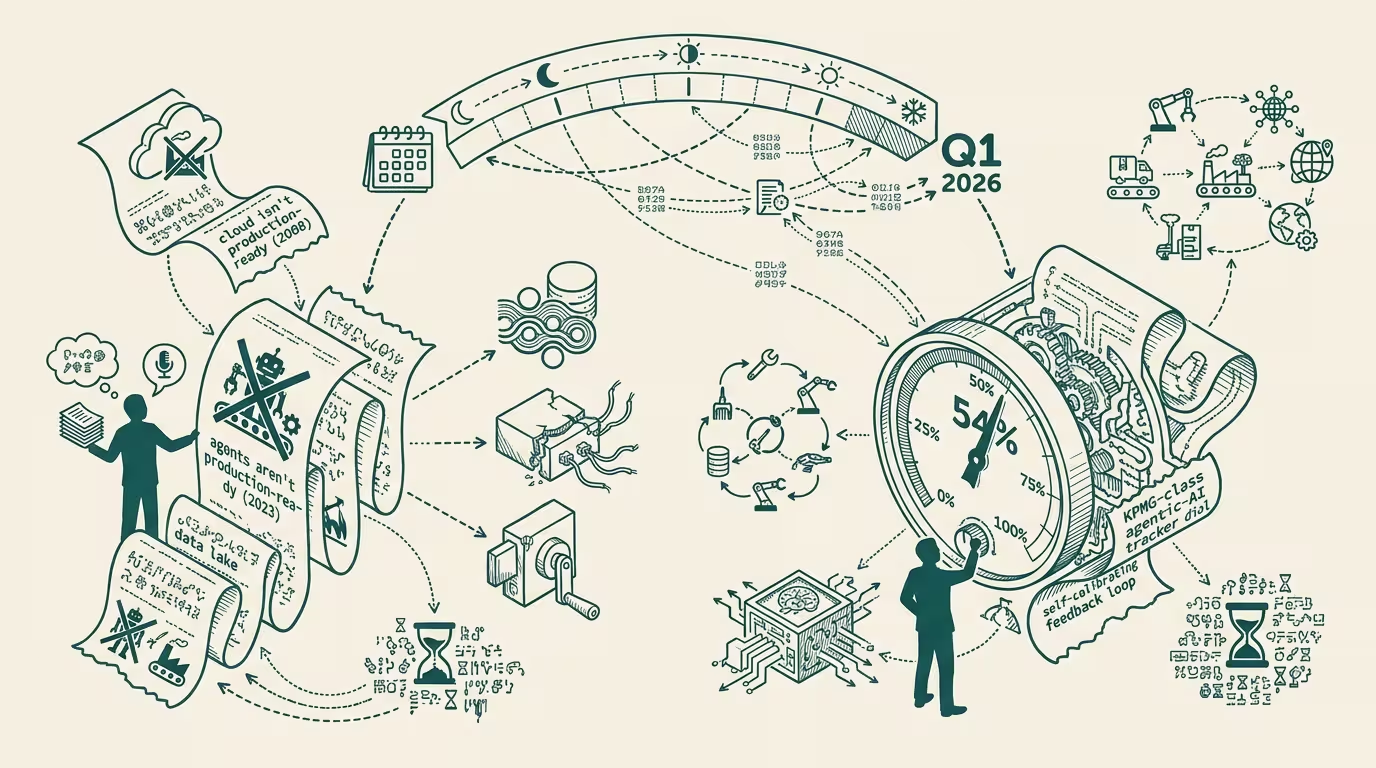
Late 2023 produced a chorus of takes that survive claiming AI agents weren't production-ready. The takes were thoughtful. The takes named the failure modes. The takes were also, in retrospect, structurally similar to the "cloud isn't production-ready" takes from 2008.
By Q1 2026 the KPMG agentic-AI tracker reported 54% of organizations had deployed agentic AI to production. _The 54% number is the receipt._
Three patterns that hold on how the take aged.
One: the failure-mode argument was correct on the merits and irrelevant to the deployment trajectory.Late-2023 critics named real failure modes (hallucination, brittle tool-use, unbounded reasoning loops, alignment-drift in long-running tasks). Each failure mode was real. Each was also a temporary state of the capability frontier rather than a structural property of agents. By mid-2025 the capability frontier had moved past most of the named failure modes; the deployment was constrained by workforce-redesign, not capability. The take's substance was correct; its trajectory implication was not.
Two: production-readiness is a moving threshold, and the discourse-class read of "not production-ready" anchors to the moment of judgment rather than to the trajectory. The 2008 "cloud isn't production-ready" take was correct as a 2008 snapshot. Inside three years it was operating-stale. The 2023 "agents aren't production-ready" take is operating-stale by mid-2025. The pattern is not an indictment of the operators who wrote the takes; it's a structural feature of how production-readiness arguments work in fast-moving capability categories.
Three: the operator-class who deployed agents in late 2024 captured a learning curve the operator-grade who waited for "production-ready" did not. Companies that deployed agents in 2024 absorbed the failure-mode costs and learned the workforce-redesign discipline. By 2026 those companies have an operating-class advantage over peers who waited. The advantage is the deployment learning, not the capability access — the capability is now broadly available; the deployment know-how is not. Operators who deferred past the late-2023 takes are now playing catchup on the workflow side.
The thing that crosses pillars is that "not production-ready" takes recur in every fast-moving category at the inception of the deployment curve. The takes are correct as point-in-time observations and structurally misleading as deployment-deferral arguments. The operator discipline is to read them as snapshots of the current capability, not as forecasts of when deployment will be ready. Categories where the same pattern is currently active in 2026: agentic-coding-at-trust-level-7+, autonomous-vehicle-class deployments at level-4 conditions, clinical-decision-support in narrow-specialty deployments. Each will produce its own version of the 54% receipt within 18-24 months.
The read that survives is that late-2023 was a decent moment for cautious operator-tier skepticism on agents and a bad moment for capital-allocation deferral against the deployment curve. Operators who got the read right deployed in 2024 and are operating-coherent in 2026. Operators who got it wrong are still presenting decks calibrated to a 2023-era capability frontier.
The "agents aren't production-ready" take aged badly. The 54% receipt is the structural counter-argument. The lesson generalizes — when the next "X isn't production-ready" take lands in your category, ask which version of the receipt is going to be visible 18-24 months from now.
—TJ