AI for hospital staffing is the only optimization that addresses both the burnout data and the org-design problem.
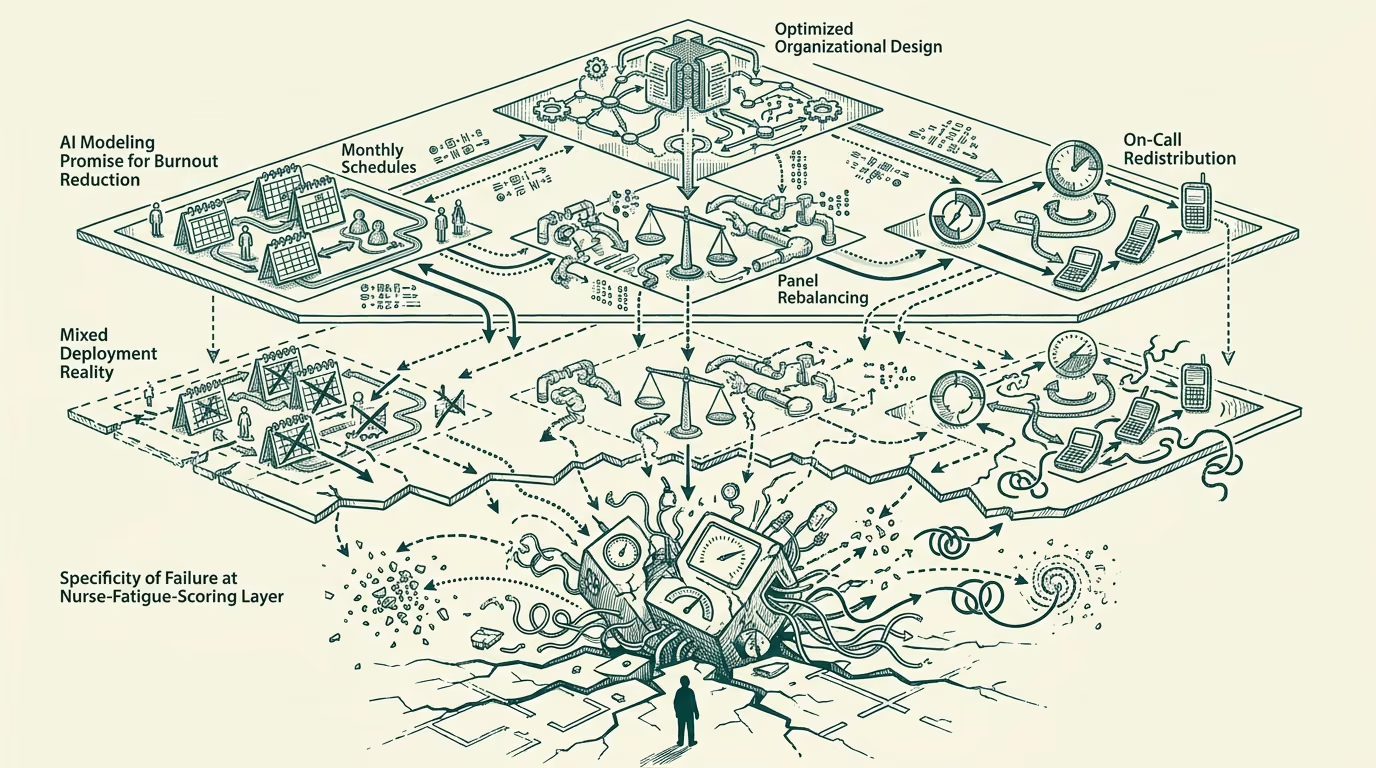
The hospital-staffing-AI category is one of the rare AI deployments in healthcare that addresses the structural-burnout problem the Canadian Medical Association surveys and the U.S. equivalent surveys have documented. The wellness-program-class interventions discussed elsewhere do not move the burnout data. The org-design changes that the data supports (reducing administrative-burden hours, rebalancing panel-size-and-capacity, redistributing on-call density) are the interventions that produce measurable burnout reduction. AI-for-hospital-staffing is the sub-category of org-design intervention that has the strongest engineering-and-deployment story attached.
The category is promising in the modeling, mixed in the deployment, and consistently runs into one specific failure mode at the nurse-fatigue-scoring layer. This explainer walks the promise, the deployment reality, the specific failure mode, and what the part that holds on the deployment trajectory should be.
What the AI-for-staffing category does
The hospital-staffing-AI category covers tools that optimize the deployment of clinical staff (primarily nurses, with some coverage of physicians, respiratory therapists, and other clinical roles) against the changing demands of the hospital's patient census, acuity profile, and operational state. The optimization runs at multiple cadences: long-cycle (monthly schedule construction), medium-cycle (weekly adjustments and float-pool deployment), short-cycle (shift-by-shift staffing decisions), and real-time (rapid-response coverage when patient acuity unexpectedly shifts).
The optimization objectives include patient-safety-and-quality outcomes, staff-fatigue-and-wellness outcomes, cost-and-efficiency outcomes, and the various contractual constraints (union rules, individual staff preferences, fairness-and-equity considerations). The combined optimization problem is multi-objective and constraint-heavy, which is the kind of problem AI-augmented optimization handles well in principle.
The category vendors include the major staffing-and-workforce-management platforms (Kronos, now part of UKG; Workday's healthcare-specific tooling; specialty vendors like Hospital IQ, Symplr, ShiftWise) plus an emerging cohort of AI-first vendors building specifically for the hospital-staffing optimization problem.
What the deployment results show
The deployment results across U.S. and Canadian hospital systems through 2024-2025 are mixed but trending positive. Hospitals that have deployed staffing-AI tools at scale report reductions in scheduling-related administrative time, improvements in float-pool utilization, lower deadhead-and-cancellation costs, and modestly improved patient-to-nurse ratios on the average shift.
The burnout-related metrics show smaller but visible improvements. Self-reported nurse satisfaction with scheduling has improved at deploying hospitals. Last-minute schedule changes, which are a documented contributor to burnout, have decreased. The intent-to-leave-the-profession metrics have moved slightly favorable at deploying hospitals relative to non-deploying hospitals, with the caveat that the longitudinal data is still building.
The mixed part is that the deployments have produced as many disappointing results as they have produced positive ones. Several major hospital systems have run staffing-AI pilots that did not produce the promised improvements and were quietly de-prioritized. The pattern of failure is not random; it concentrates in one specific area.
The nurse-fatigue-scoring failure mode
The specific failure mode that consistently bites in staffing-AI deployments is the nurse-fatigue-scoring layer. The optimization tools generally include a fatigue-and-wellness component that scores individual nurses against their recent shift history, sleep estimates from electronic-health-tracking integration, and the broader fatigue-related signals the optimization can access. The score is meant to feed into the staffing optimization to avoid scheduling fatigued nurses for high-acuity shifts.
The failure mode runs in two reinforcing directions.
The first direction is that the fatigue scores are often inaccurate. The signals the score is built from (shift history, electronic-health-tracker data when available, self-reported wellness check-ins) do not adequately capture the actual fatigue state of the nurse. The score produces false positives (scoring a well-rested nurse as fatigued) and false negatives (scoring a fatigued nurse as ready). The inaccuracy is high enough that the staffing optimization that uses the score produces decisions the nurses themselves disagree with, which erodes trust in the system.
The second direction is that the score, even when accurate, produces uncomfortable interactions with the existing labor-relations-and-individual-autonomy framework that hospital-nurse staffing operates within. The nurse who is told by the AI system that they are fatigued and cannot be scheduled for a high-acuity shift, with no input from the nurse themselves, experiences the AI system as paternalistic and as undermining their professional autonomy. The interaction produces friction that the deployment cannot easily resolve.
The combined effect is that the fatigue-scoring layer, which is structurally the layer that should produce the largest burnout-reduction benefit, is also the layer that produces the most operational and cultural friction in the deployment. The hospitals that have managed the fatigue-scoring layer carefully (with strong nurse-input mechanisms, transparent scoring methodology, override-and-discussion infrastructure) have produced positive deployment outcomes. The hospitals that have deployed the fatigue-scoring layer without the nurse-engagement work have produced the failed-deployment shape.
What the operator class should take from this
For hospital systems evaluating staffing-AI deployment, the practical advice is to plan against the fatigue-scoring failure mode explicitly. The optimization tools' base functionality (scheduling-construction, float-pool deployment, shift-by-shift adjustments) generally produces operational benefits without the friction. The fatigue-scoring layer should be deployed with substantial nurse-engagement infrastructure, transparent methodology, and explicit override mechanisms. Hospitals that skip the engagement work get the friction without the benefit; hospitals that invest in the engagement work get both.
For staffing-AI vendors building products in this category, the durable read is that the fatigue-scoring layer should be treated as the harder engineering-and-deployment problem rather than as the easier add-on feature. Vendors that have invested in the fatigue-scoring infrastructure (with multi-source signal fusion, transparent methodology, nurse-facing explainability, strong override infrastructure) have stronger deployment outcomes. Vendors that have shipped the fatigue-scoring layer as a feature without the supporting infrastructure have produced the failed-deployment outcomes that drag down the category-level reputation.
For investors evaluating the staffing-AI category, the read is that the category is genuinely promising for the burnout-and-org-design problem the broader healthcare-AI investment is trying to address, with the caveat that the fatigue-scoring layer is the specific risk dimension the diligence should attend to. Vendors who have a credible answer for this layer are differently-priced from vendors who do not.
The hospital-staffing-AI category is the rare intersection where the AI investment actually addresses the structural problems the burnout-data has surfaced. The deployment trajectory through 2025-2026 will continue to be mixed, with the variation being substantially driven by how each hospital manages the fatigue-scoring layer rather than by the underlying optimization quality. Operators who recognize this and invest in the engagement-and-infrastructure work that the fatigue-scoring layer requires will produce the durable outcomes; operators who do not will continue to produce the mixed results the category has been showing. The math says the category should work. The deployment work is the work that determines whether it does.
—TJ