AI for pharmacy operations is undersold.
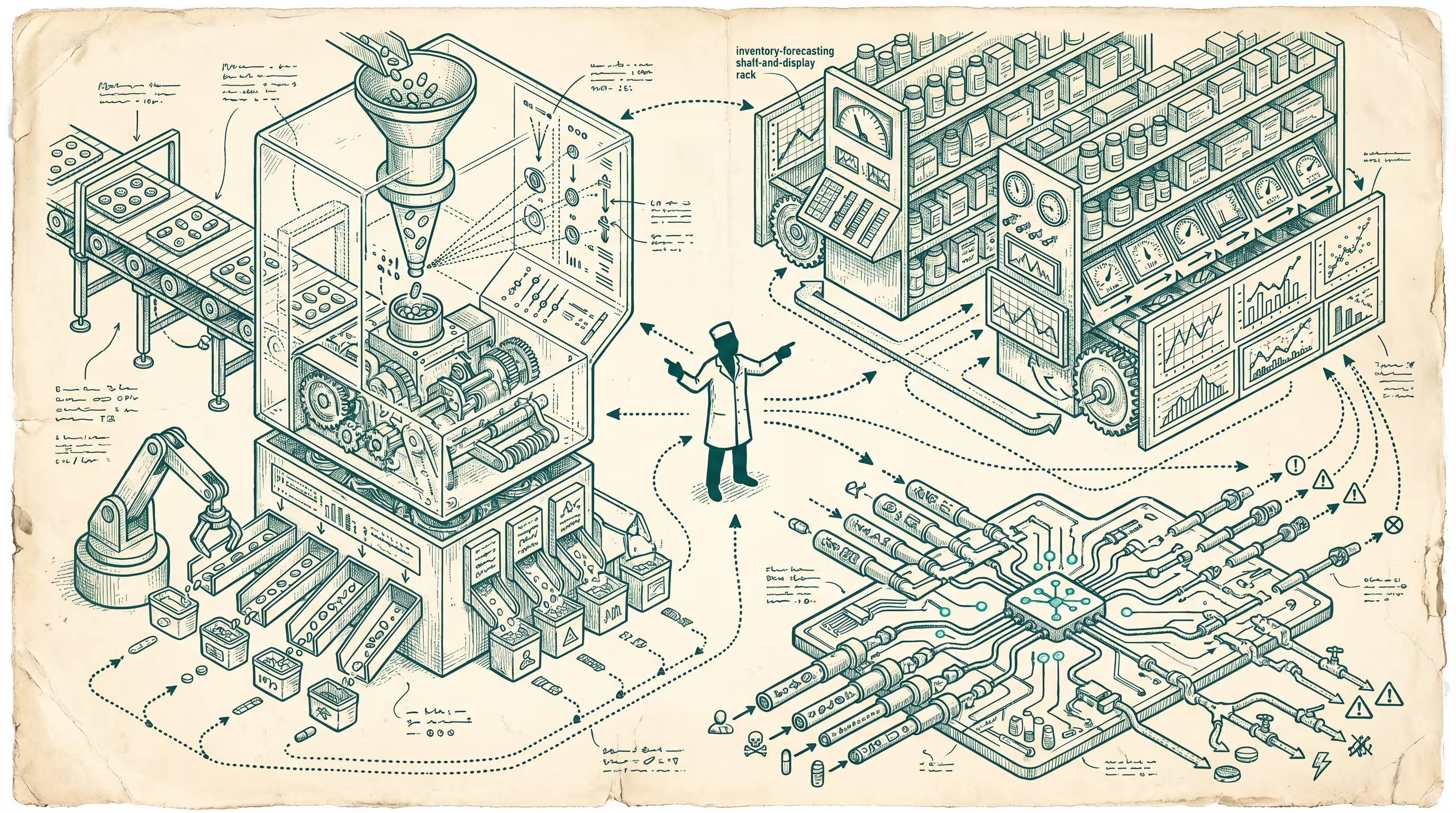
The AI-for-pharmacy-operations category is the most undersold application of the current generation of machine-learning and rule-based-automation systems, and it is undersold for an unflattering reason: the operators who would benefit most are the people the discourse pays the least attention to. Retail pharmacy is not a hot category in 2024. Hospital systems are. Drug discovery is. Patient-facing chatbots are. Pharmacy ops is the same boring boxes-on-shelves problem it has been for thirty years, and that is exactly why the application surface is so large and so underused.
Three operational sub-problems are worth naming, because they are where the real cash is. First, pill counting and bottle identification at the dispense step. The error rate in manual counting is non-zero in a way that produces both adverse events and litigation, and the workflow burns pharmacist attention on a task with no clinical content. Computer-vision systems that verify counts and identify the medication against a database have been deployable since at least 2020 in the technical sense, and the actual deployments at Walgreens micro-fulfillment centers (about 4,300 supported stores at the end of 2023, on a goal of roughly 5,000 by end of 2024) plus CVS’s centralized fulfillment work are the proof. The slower-moving independents and regional chains, which dispense roughly a third of US prescriptions in aggregate, have almost none of this. The unit economics for a vendor selling them a turnkey vision-plus-routing product are excellent and almost no one is selling it.
Second, inventory and reorder. The drugstore inventory problem is unforgiving in two directions: under-stock and you lose the script to a competitor and possibly the patient for the rest of the year, over-stock and you tie up cash and absorb expiry risk on regulated SKUs that you cannot liquidate. Demand forecasting that combines local prescribing patterns, weather, seasonal-illness signal, and manufacturer-shortage feed has been a research topic for twenty years. The barrier to deployment has never been the model. It has been integration into the pharmacy management system that the corner store is already paying for. The right product is not a forecasting startup. It is a forecasting module that sits inside QS/1, PioneerRx, Liberty Software, or whatever the chain’s existing system is, and quietly adjusts par levels on a nightly run. The vendors who solve the integration problem capture the category. The vendors who keep selling a separate dashboard never will.
Third, drug-interaction routing and clinical-review triage. Pharmacists see hundreds of interaction warnings per day from the existing software, and the warning-fatigue problem is well-documented enough that the more-experienced pharmacist learns to ignore most of them. The right product here is not a better warning. It is a triage system that scores warnings by the clinical signal in the patient’s history, the recent-prescriber pattern, and the medication class, and surfaces only the warnings that warrant a pharmacist call. This is a routing-and-rules problem layered on top of a small language model with access to the clinical chart. The patient-safety gain is large, the workload reduction is large, and almost nobody is building it as a product because the buyer is not glamorous and the technical problem looks small from the outside. It is not a small problem. It just looks small.
These three sub-problems share a structural feature that the AI discourse keeps missing in 2024. They are all routing- and-rules problems with a small machine-learning component, not the inverse. The temptation in the current cycle is to reach for the largest available model, fine-tune on pharmacy text, and ship a generative chatbot. That product gets attention and does not work in the workflow. The product that works is boring: a deterministic router with a small learned component for the parts where the determinism breaks down, glued tightly into the existing pharmacy management system, with a deployment story the corner-store pharmacist can understand in fifteen minutes. The companies that win this category will not be the companies on the AI panels. They will be the companies that hire ex-pharmacy-software engineers and ship integration adapters.
The undersold part is also commercial. The aggregate independent and regional pharmacy market, plus the long-tail of mid-size chains, plus the small but cash-rich long-term-care pharmacy segment, plus the hospital outpatient pharmacy footprint, comes to a total addressable spend in the high single-digit billions of dollars per year for operational software. That spend is currently captured by a handful of legacy pharmacy management vendors selling modules that have not changed materially in a decade. A well-built pill-vision-plus-inventory-plus-triage product, integrated into the existing systems via the standard interfaces (NCPDP scripts, the underlying SQL stores in PioneerRx and QS/1, the HL7 feed from the dispense robot), is in a position to replace those modules at a higher price point and a better gross margin than any of the current vendors are running. The reason this has not happened yet is not that the technology is missing. It is that the category is not exciting to talk about and the buyer is not in San Francisco.
Three checkpoints to watch through 2024 and into 2025. One, whether any of the existing pharmacy management vendors ships a vision-and-triage module in their core product rather than buying a startup and bolting it on; if a legacy vendor moves first the category gets compressed. Two, whether a new entrant emerges with a credible integration story across at least two of the major pharmacy management systems; the integration moat is the moat. Three, whether the chain pharmacies start publishing dispensing- error and pharmacist-time-allocation metrics that would force the independents to compete on operational quality rather than location and price; without that pressure the independents will keep tolerating the status quo. The most likely outcome is that the category quietly produces two or three winners over the next four years, none of them named in the AI press, all of them with revenue per employee that looks more like vertical SaaS than like AI-startup metrics, and the discourse will inevitably treat their eventual acquisition by a chain or a PBM as a surprise. It will not be a surprise. It will be the thing that was already obvious to anyone who had ever stood behind a pharmacy counter.
—TJ