AI pricing creates two consumer outcomes. Regulation only sees one.
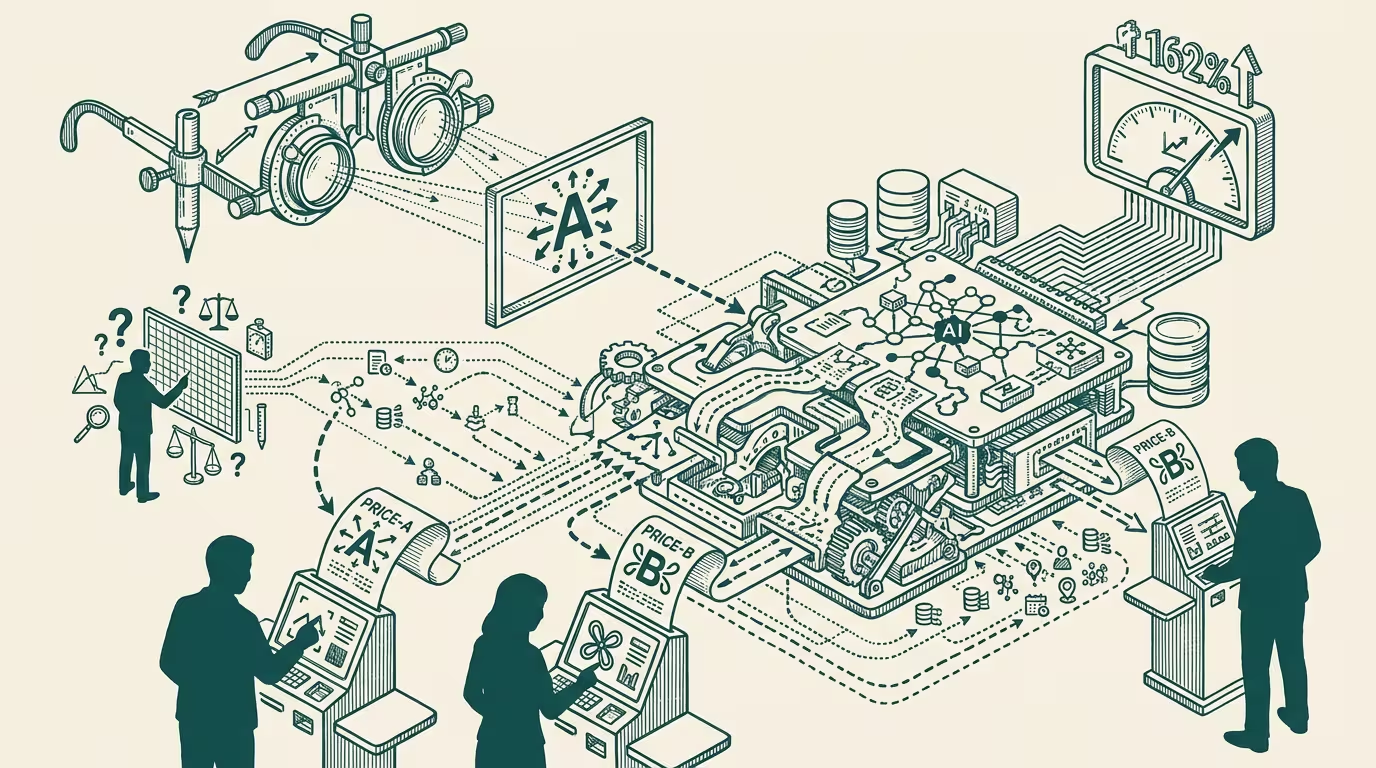
University of New South Wales researchers published findings in mid-2025 confirming what the operator class had been observing in inventory data for two years: two consumers see different prices for the same flight at the same time. The differentials weren't subtle (single-digit percentages) — they were operationally significant (15-40% on certain routes for high-purchase-intent versus low-purchase-intent customers).
Booking.com's own published data on the same arc showed AI-personalized discounts drove a 162% sales increase, with the lift concentrated in the low-purchase-intent customer cohort. Translation: AI pricing isn't uniformly raising prices. It's _selectively lowering_ them for customers the AI judges as unlikely to convert without a discount.
How does the same product have two prices simultaneously? AI personalizes it. A high-purchase-intent customer pays the full price the AI judged sustainable. A low-purchase-intent customer gets a discount the AI judged necessary for conversion. From the seller's operating perspective, the practice is rational revenue optimization. From the high-intent customer's perspective, the practice looks like price-gouging. From the low-intent customer's perspective, the practice looks like a discount.
What does the regulatory frame see? Only one outcome at a time. Consumer-protection regulation is calibrated to the high-intent-pays-more reading and not to the low-intent-pays-less reading. Discrimination law, FTC enforcement, and state-level consumer protection regulations are designed to engage with practices that uniformly raise prices for protected classes. A practice that uniformly lowers prices for some consumers is harder to regulate because the lower-priced cohort doesn't have a regulatory complaint and the higher-priced cohort can't easily prove the differential without protected-class status. The regulatory architecture assumes uniform effect; AI pricing produces split effect; the architecture is operationally underprepared.
What's the operator-class window? Wider than the regulatory-class signal suggests. Through 2025-2027 the regulatory class will engage with personalized pricing in narrow categories (insurance, mortgage, employment). Each engagement will produce category-specific rulemaking with category-specific carveouts. AI pricing in travel, retail, and hospitality is operating-deployable through this window without near-term regulatory exposure because the regulatory frame engaging those categories doesn't have the apparatus to address split-outcome pricing. By 2028-2029 the regulatory frame will have absorbed the question; until then, operators deploy under regulatory ambiguity.
What's the cross-category arc? The same playing-out that runs through every adversarial-AI-against-customers category. The AI capability deploys ahead of the regulatory frame, the consumer absorbs the cost of the deployment for the duration of the regulatory lag, and operators capture the operating leverage during the lag window. AI pricing is one example. AI fraud detection in financial services is another. AI claim-denial in insurance is a third. Each category has its own version of the lag.
Cut through to the durable read and the picture is sharp. AI pricing in travel is one of the cleaner 2025 examples of the split-outcome pricing structural problem, consumer-protection regulation is operationally underprepared for the split-outcome shape, and the operator-tier window for deployment is wider than the consumer-discourse arcs suggest. Operators deploy. Consumers absorb. Regulators catch up later. The regulatory frame's eventual response will be category-specific, will lag the deployment, and will not reverse the deployments already shipped.
AI pricing creates two consumer outcomes. Regulation only sees one. That gap is the operating window. Operators in the window are operating-coherent. Operators waiting for regulatory clarity are absorbing the wait cost while peers compound the deployment learning.
—TJ