Air Canada's attendants struck the unpaid hour. The 50-year norm broke.
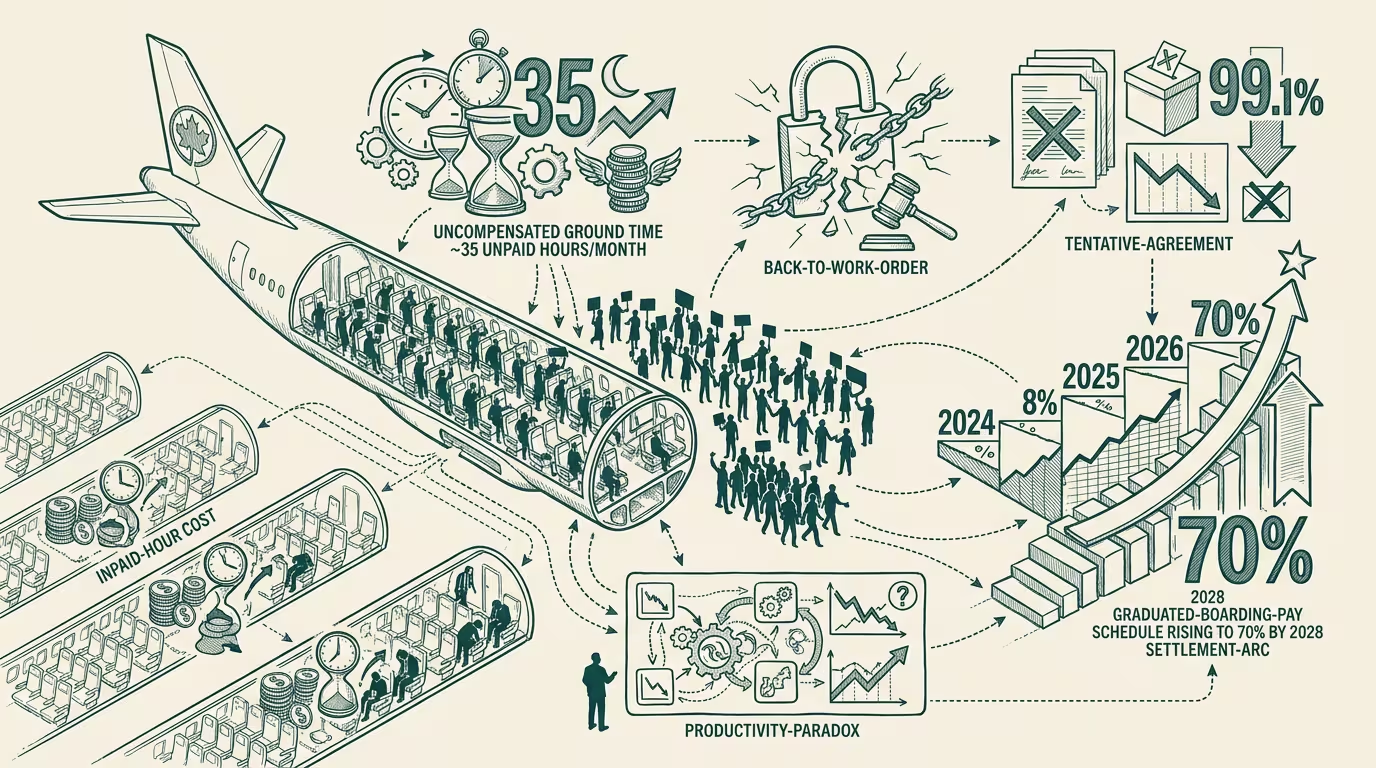
Ten thousand CUPE-represented Air Canada flight attendants struck on August 16, 2025. The trigger was uncompensated ground time — roughly 35 unpaid hours per month per attendant for boarding, deplaning, delays, and pre-flight duties. The strike defied a federal back-to-work order. The first tentative agreement was rejected 99.1% in the union's ratification vote. A second tentative agreement, negotiated under continued striking pressure, included graduated boarding pay rising to 70% by 2028. The work stoppage ran into the second week. By the time the deal closed, Canadian travel had absorbed weeks of cancellations and the policy class had a labor-cost story with a five-year disclosure tail.
This piece treats the Air Canada strike on its own terms — the case-study mechanics — and then opens out to the cross-pillar pattern, because the durable read on the strike depends on recognizing that the unpaid-ground-time norm is not a Canadian story.
The strike: case-study mechanics
The 35-hours-per-month figure was the union's load-bearing claim. The math is straightforward: a typical attendant flies 80-90 hours of paid air time per month; the boarding, deplaning, delay, and pre-flight tasks add roughly 35 hours of unpaid ground time. The unpaid hours are work in every operating sense — the attendant is in uniform, on premises, performing assigned duties — but were classified outside the compensation envelope by a 50-year industry convention dating to deregulation-era contract structures.
The federal back-to-work order was issued under Canada Labour Code Section 107 on August 16, 2025. The union defied it, which is rare in Canadian labor history and politically expensive for the union leadership. The defiance signaled that the unpaid-hour issue was load-bearing enough that the union would absorb the regulatory exposure rather than accept a back-to-work-without-deal outcome. The federal labor board's response was constrained — the political class was not willing to use the full enforcement apparatus against a deeply popular striker class — and the strike continued.
The first tentative agreement, presented for union ratification on August 23, was rejected 99.1%. The rejection rate is, by labor-history standards, an extraordinary signal. Standard tentative-agreement rejection rates in airline-class labor disputes run 30-50%. A 99.1% rejection means the membership read the deal as not merely insufficient but as not engaging with the central issue at all. The bargaining team had to return to the table with fundamental reframing on the unpaid-time question.
The second tentative agreement included graduated boarding pay — 50% of regular pay rate for boarding hours starting late 2025, rising to 70% by 2028. The graduated structure was the political-economy compromise: full pay would have set a precedent the airline industry was not willing to validate; zero pay would have been rejected again. The graduated phase-in let both sides claim a partial win and let the airline absorb the cost over a multi-year amortization curve.
By the deal's signing, the strike had cost Air Canada roughly C$170M in operating impact (cancellations, customer-compensation, IRROPS-class disruption costs, brand impact). The CUPE local had spent its strike fund and accepted significant individual member financial pressure. The federal government had absorbed political cost on the back-to-work-order defiance question. The deal closed because all three parties had run out of acceptable alternatives.
The cross-pillar pattern: unpaid ground time is industry-wide
The Air Canada strike is a clean case study because the issue is sharply named and the resolution is publicly disclosed. The pattern the strike exposes is industry-wide, and the part that holds depends on recognizing the broader scope.
The American Airlines flight-attendant labor dynamics through 2024-2025 were running parallel. The Association of Professional Flight Attendants (APFA) negotiated a contract with American in late 2024 that included partial boarding pay — the first U.S. legacy carrier to compensate ground time, following Delta's similar move in 2022. The American deal was, in operating terms, a leading indicator of where the U.S. industry was heading on the same question Air Canada's CUPE local was forcing in 2025. The post-Air-Canada-strike read was that the unpaid-ground-time norm was breaking across the industry, not just at one carrier.
United and Southwest had been negotiating their own flight-attendant contracts through 2024-2025 with the unpaid-time question as a load-bearing item. By Q4 2025, both carriers had moved toward graduated-boarding-pay structures similar to the Air Canada outcome. The cross-carrier convergence was the structural confirmation that the unpaid-ground-time norm had broken at the industry level.
The post-COVID aviation labor environment carries a productivity paradox. Carriers absorbed losses through 2020-2022 by under-paying labor categories that the federal-aid distribution did not protect. Flight attendants, gate agents, and ground crew absorbed disproportionate compensation pressure. By 2024-2025 the labor-class power had recovered enough to demand the structural compensation changes that the post-COVID-aid-period had deferred. The Air Canada strike was one of the larger visible markers of the labor-class recovery; the cross-carrier pattern was the broader confirmation.
The operator-class question is what the labor-cost line item looks like across the industry under the new norm. The arithmetic is approximately: 35 unpaid hours per month at graduated 50-70% of regular rate is roughly $3,000-$5,000 per attendant per year in additional compensation. Across the U.S. major carrier flight-attendant workforce of approximately 100,000 attendants, the industry-level cost is $300M-$500M per year on a steady-state basis. The cost is recoverable through fare increases or through productivity improvements; the absorption mechanism varies by carrier.
The synthesis: post-COVID aviation labor is a public timeline
The 50-year industry-wide unpaid-ground-time norm broke in 2024-2025. The break is now a labor-cost line item with a public disclosure timeline — the graduated phase-ins are visible in carrier earnings reports, the cross-carrier convergence is visible in industry-class data, and the political-class read on aviation labor is repriced. The post-COVID productivity paradox is now operating-visible at the labor-cost layer.
What follows for carrier labor-cost guidance is that every carrier's post-2025 model has to absorb the unpaid-ground-time conversion. The cost is real, the timing is graduated, and the mechanism is non-reversible. Investor-class analysts modeling carrier margins in 2026-2028 have to absorb the conversion cost. Operators in adjacent travel categories (hotels, OTAs, travel-tech vendors) have to model the carrier-margin compression as a downstream effect.
What follows for the labor-class power dynamics is recurrence in adjacent under-compensated airline-labor categories. Gate agents, ground crew, customer-service-center staff are the next-tier under-compensated categories. The pattern that worked for flight attendants — strike-defies-back-to-work-order, ratification-rejection-forces-reframe, graduated-phase-in-resolves — is now a known playbook. Adjacent labor categories will run the playbook in 2026-2028 across multiple carriers.
What follows for the regulatory frame is a structural shift on airline labor. The political class's willingness to use back-to-work orders against deeply-popular striker classes is constrained. Air Canada's strike succeeded partly because the federal government was politically constrained from full enforcement. U.S. and other-jurisdiction labor disputes will calibrate to the same political-class constraint. The structural read on the airline-labor regulatory environment in 2026-2028 has to assume weaker enforcement than the 2018-2022 baseline.
What the operator-class plan does with this
The operator class — carrier executives, travel-tech vendors with carrier exposure, OTA platforms with airline-product mix, hospitality operators with adjacent labor-class exposure — has to absorb the labor-cost conversion in the 2026-2028 plan. The plan that does not is operating-thin. The plan that absorbs the conversion at the cross-carrier industry level is operating-coherent.
The plan that goes further — anticipating the next-tier labor-class dispute in gate-agent or ground-crew categories — is the plan that captures the operator-tier advantage from the structural shift. Most carriers are operating one tier behind on the question. The carriers operating ahead of the curve are the ones whose 2028 labor-cost line item is calibrated to the new norm rather than to the legacy norm.
What survives all of this is that Air Canada's strike was one of the cleaner visible markers of a 50-year industry-wide labor norm breaking, the cross-carrier pattern through 2024-2025 confirmed the break at the industry level, and the part that holds for the 2026-2028 cycle is to model the labor-cost conversion as a fixed feature of the new operating environment. The carriers and operators that absorb the conversion smoothly capture the productivity-paradox-resolution upside. The ones that resist the conversion absorb the disruption cost in their own labor disputes.
The 50-year norm broke. The labor-cost timeline is public. The next decade of aviation labor cost is calibrated to the post-Air-Canada-strike baseline, not to the pre-strike baseline. Operators planning against the pre-strike baseline are operating against a baseline that no longer exists.
—TJ