Why the dental-vision-hearing exclusion will outlive every Medicare reform.
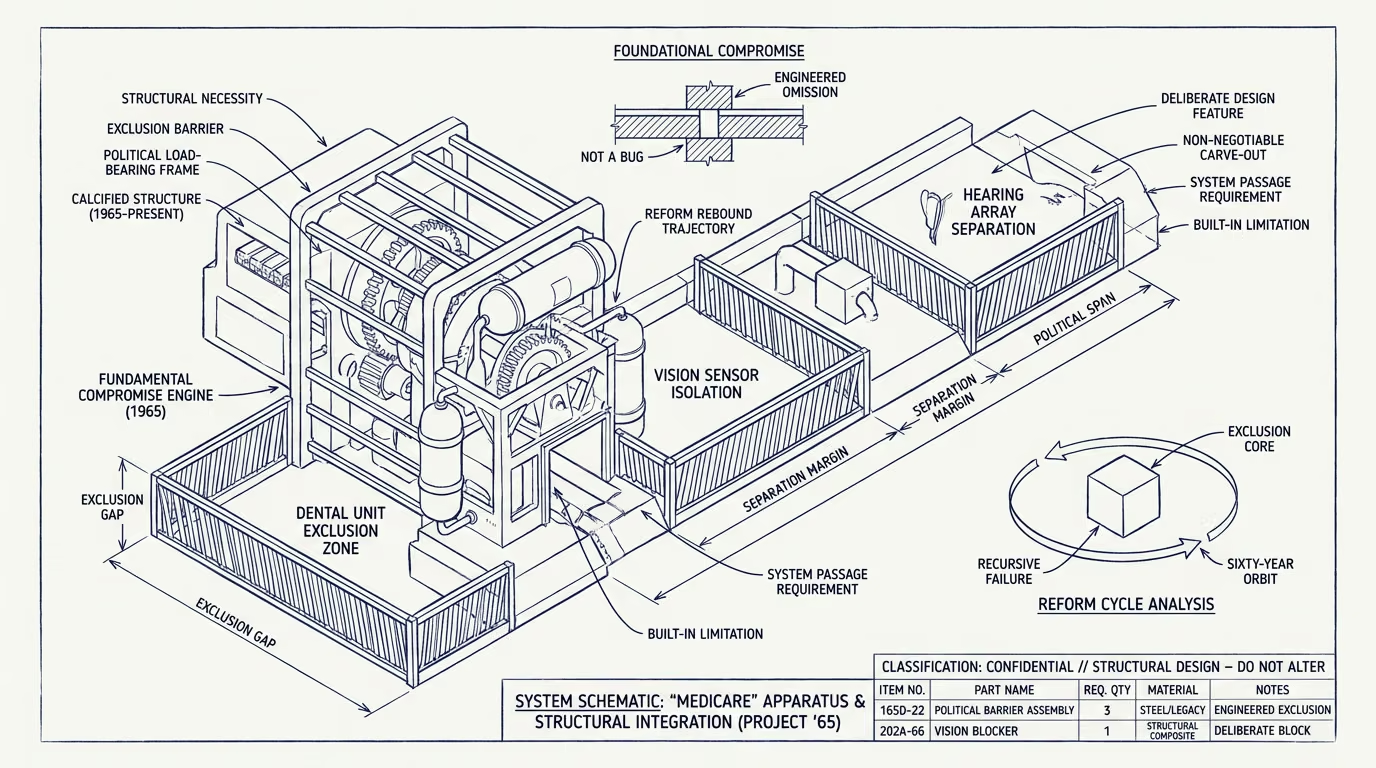
The dental-vision-hearing exclusion from traditional Medicare is the most politically immovable element of a sixty-year-old program that has been reformed, expanded, and rewritten more times than any other piece of U.S. social policy still in continuous operation. Every administration since at least Carter has put a DVH expansion on the table. None of them got it through. The 2021-2022 Build Back Better attempt was the most serious legislative push in a generation and it failed for the same reason every prior attempt failed. The Medicare Advantage carve-ins of the 2000s and 2010s have shifted the coverage landscape on the margin without addressing the underlying exclusion in the traditional program. The exclusion is not surviving because nobody has tried to remove it. It is surviving because the program's structural politics make it the part of Medicare that resists reform the way it resists reform.
This is an explainer. The intent is to walk the 1965 design choice that produced the exclusion, the sixty-year sequence of attempted reforms, the structural reason each attempt fails, and what an actual practical fix looks like that moves coverage at the population level rather than the policy-discourse level.
The 1965 design choice
The Medicare program as enacted in 1965 was the result of a multi-decade legislative compromise that finally cleared the political coalition required to pass national health insurance for the elderly population. The compromise was bounded in several specific ways. The program covered acute medical care (hospitalization in Part A, physician services in Part B). It did not cover prescription drugs (a gap that would not be filled until Part D in 2003). It did not cover long-term care (a gap that has never been filled). And it did not cover the dental, vision, and hearing services that the AMA and the AHA, the two professional organizations whose support was structurally required to pass the bill, did not consider part of the medical-services scope they were endorsing.
The DVH exclusion was not an oversight. It was a deliberate scope decision. Dental care was professionally separated from medical care in the U.S. by the late nineteenth century, and the dental-school-and-practice ecosystem operated as a parallel and largely independent system from the medical one. Vision care occupied a similar position, with optometrists and ophthalmologists running a separate professional and reimbursement infrastructure. Hearing services, less professionally organized, were similarly outside the medical scope the AMA was prepared to endorse for federal coverage.
The Medicare bill that got passed was the bill that the medical-and-hospital coalition would let pass. Adding DVH would have meant either pulling the dental, optometric, and audiology professional organizations into the coalition (which would have required different negotiations and was not on the table in 1964-1965) or carrying the bill over the active opposition of those organizations (which would have made the medical-and-hospital coalition harder to keep). Neither option was politically available. The DVH exclusion was the price of getting medical coverage passed.
That history matters because it produced an exclusion that was structurally entangled with the professional and reimbursement infrastructure of three separate practice categories that had spent the prior half-century deliberately positioning themselves outside the medical-services scope. Reversing the exclusion would require either bringing those three categories into a unified federal coverage and reimbursement framework (which they have generally resisted) or running them as carve-out coverages with their own dedicated administrative infrastructure (which has been politically and operationally difficult to scale).
Sixty years of attempted reform
The reform record is consistent. The Carter administration considered a DVH expansion as part of a broader Medicare reform package and dropped it under the political-coalition pressure that has dropped every subsequent attempt. The Reagan-era Medicare reforms went the opposite direction, focused on cost containment rather than scope expansion, and DVH was not on the agenda. The Clinton-era Health Security Act of 1993 included a partial dental component for certain populations and lost in the broader bill failure. The Obama-era Affordable Care Act of 2010 deliberately did not address DVH for traditional Medicare, choosing to spend its political capital on the broader coverage expansion and leaving Medicare's structural design largely in place.
The Medicare Advantage program, which has grown substantially since the 2003 Medicare Modernization Act and accelerated through the 2010s and 2020s, has carved in DVH benefits as an attractor for plan enrollment. By 2024, roughly 90 percent of MA plans included some level of dental coverage, 99 percent included some vision coverage, and 95 percent included some hearing coverage. This sounds like the exclusion has been substantially addressed. The detail underneath it is that the MA dental coverage is generally limited (annual benefit caps in the $1,000-$3,000 range, restricted provider networks, exclusions for higher-cost procedures), the vision and hearing coverage is similarly bounded, and the coverage applies only to the roughly 50 percent of Medicare beneficiaries who have chosen MA over traditional Medicare. The other 50 percent, on traditional Medicare, still face the original exclusion.
The 2021-2022 Build Back Better attempt at expanding traditional Medicare DVH coverage was the most serious legislative push since Medicare's enactment. The early version of the bill included dental, vision, and hearing benefits at meaningful levels. The bill was progressively scaled back through negotiation, with the DVH provisions being among the first elements cut as the bill was downsized to fit the procedural constraints of reconciliation. The hearing provision survived in modified form; dental and vision did not. The pattern repeated the pattern: the political coalition required to pass the broader package would not carry the full DVH expansion, and DVH was the part that got dropped first.
The structural reason each attempt fails
Each reform attempt fails against the same structural problem. Adding DVH to traditional Medicare requires three things that are individually difficult and that have not aligned simultaneously in any reform window.
The first is significant federal spending on a non-acute scope of care that the budget process has historically deprioritized in favor of acute-care expansion (Part D in 2003, the ACA's coverage expansion in 2010). DVH expansion at meaningful levels costs hundreds of billions of dollars over a ten-year window. The reconciliation process that has carried most Medicare reforms is structurally allergic to spending of that magnitude on a single program element when other priorities are competing for the same budget envelope.
The second is restructuring the dental, optometric, and audiology professional and reimbursement infrastructure to integrate with Medicare's administrative-and-payment systems. The integration is non-trivial. The fee schedules, prior-authorization frameworks, network-adequacy standards, and quality-measurement infrastructure that Medicare runs for medical services do not exist for dental, vision, or hearing at the federal scale. Building them takes years and requires the cooperation of professional organizations that have historically not wanted to be inside Medicare's reimbursement framework, because being inside it constrains their pricing flexibility.
The third is overcoming the active lobbying opposition from the parts of the dental and audiology industries that benefit from the current pricing structure. Dental services in the U.S. operate at retail-margin levels that a Medicare-fee-schedule integration would compress. The industry organizations representing those interests have been consistent and effective opposition to every prior reform attempt. The political coalition needed to pass DVH expansion has to absorb that opposition. No coalition since 1965 has been able to.
The combined structural problem is that DVH expansion requires significant federal spending, significant administrative-system restructuring, and significant political-coalition assembly, all in the same reform window. The combination has not aligned. The pattern of the last sixty years is that one or two of the three are present in a given reform window and the third blocks. The exclusion survives.
What the practical fix actually is
Given the structural pattern, the practical-fix question is not "how do we pass federal DVH expansion." That has been the question every reform attempt has tried to answer, and the answer has consistently been "we cannot, in the current political coalition." The practical-fix question is "what shifts coverage at the population level without requiring the federal expansion to clear."
The answer that has actually been shifting coverage is the Medicare Advantage growth pattern. As MA enrollment continues to grow (now exceeding 50 percent of Medicare beneficiaries and projected to continue rising through 2030), the share of Medicare beneficiaries with at least some DVH coverage rises with it. The coverage is bounded and the network constraints are real, but the trajectory is toward a larger share of the population having some coverage.
A second practical fix is at the state level. Several states have explored Medicaid-Medicare integration mechanisms that include DVH benefits for the dual-eligible population (the population eligible for both programs, which skews lower-income and higher-need). The dual-eligible program is structurally a place where DVH coverage can be added without passing federal Medicare reform, because the integration runs through Medicaid, where DVH coverage already exists for many states.
A third practical fix is at the employer level. Employer-sponsored retiree health benefits that supplement Medicare often include DVH coverage. The trajectory of these benefits is mixed (declining for new retiree cohorts, stable for existing ones), but the segment of the Medicare population covered through employer-supplement is not negligible.
A fourth practical fix is at the consumer level through the Medicare-supplement and standalone-DVH-insurance markets. These products are imperfect and bounded by the actuarial-and-network constraints of any private insurance product, but they exist, and the share of beneficiaries using them has grown.
The combined practical fix is not federal Medicare reform. It is the layered set of mechanisms (MA growth, dual-eligible programs, employer supplements, private-market DVH) that route around the structural barrier the federal reform has not been able to clear. The trajectory of population-level DVH coverage is moving, slowly, in the direction of higher coverage, through these mechanisms.
The structural fact, which is why this piece is titled the way it is titled, is that the federal DVH exclusion will probably outlive every reform that attempts to remove it through the next decade and likely beyond. The political coalition required to pass the federal expansion has not assembled in sixty years and the structural conditions producing that pattern have not changed. The practical-policy work for the operator class that cares about coverage outcomes is in the layered-mechanism work that routes around the federal exclusion, not in waiting for the federal expansion that the structural politics keep blocking. That is the explainer the policy discourse has been generally not running. The exclusion is the wall. The work that moves coverage is the work that goes around it.
—TJ