Expedia's 10-K named agentic AI. The board owns the threat now.
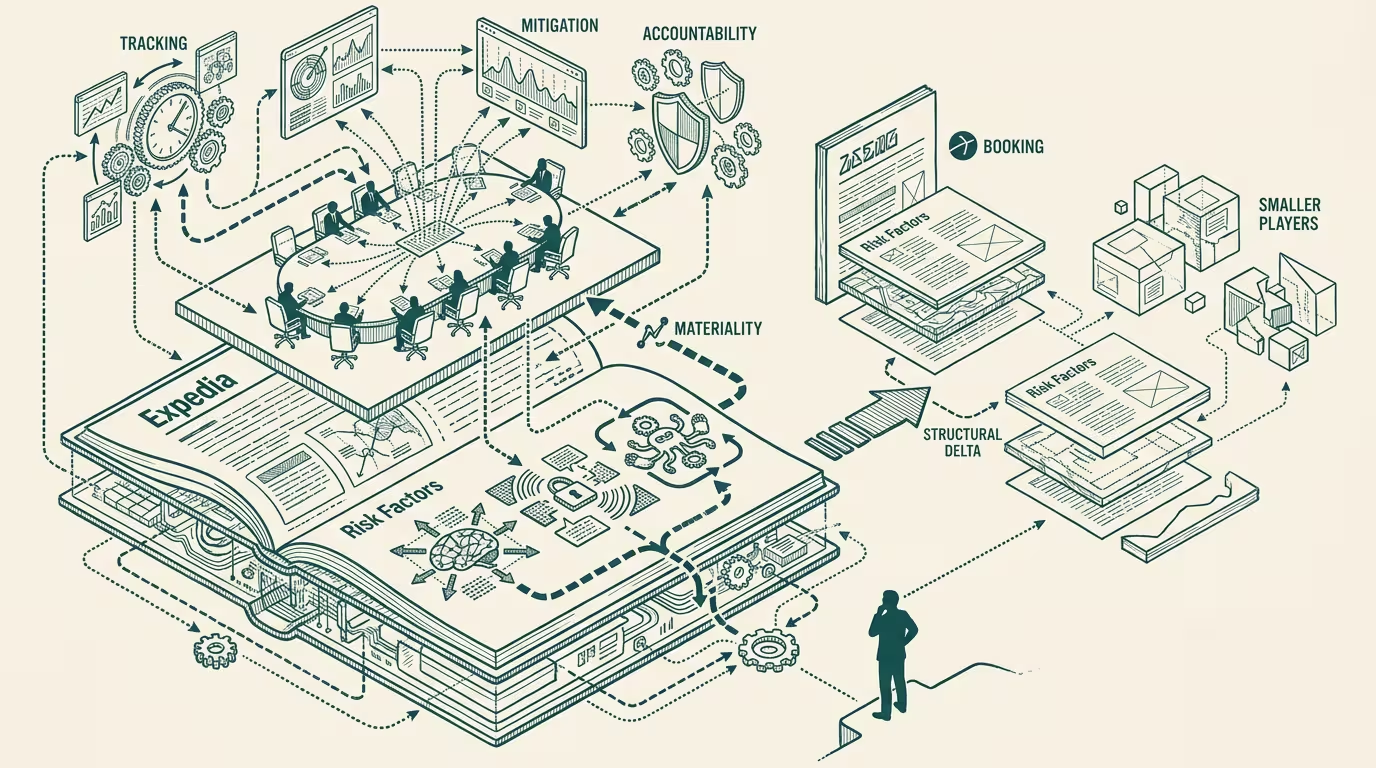
Expedia filed its 10-K annual report in February 2026. The risk-factor section explicitly listed AI-powered competitors, data risks, and agentic AI as material risks to the business. The trade press wrote it up as "Expedia acknowledges AI threat." The structural read is structurally sharper.
When a public company discloses a specific risk in its 10-K, the company's board has accepted that risk as real, material, and operationally bounded enough to be communicated to investors. The 10-K is, in regulatory terms, the document the board signs. Once the disclosure lands, the question shifts from "is the disruption happening" to "how is the operator class redirecting capital under the new acceptance."
That is the structural shift that matters.
_Pre-disclosure, the agentic-AI threat was an analyst-class debate._ Skift wrote about it. The travel-tech press wrote about it. Stock analysts modeled it speculatively. Post-disclosure, the threat is a board-acknowledged operating reality. The capital allocation that follows the disclosure is calibrated to the threat being real.
What does the disclosure trigger across the OTA category? A cascade. Expedia is the first major OTA to file the disclosure. Booking and Airbnb's 10-Ks (or 10-K equivalents) will land within 60-90 days of Expedia's filing. The Booking and Airbnb language will, in 2026, almost certainly include similar agentic-AI risk disclosure. The cross-OTA disclosure cascade is the structural confirmation that the threat is industry-acknowledged. The investor-class repricing of OTA equity that follows is calibrated to the cross-OTA acknowledgment, not just to Expedia's individual filing.
What does the operator-class actually watch for? Not the disclosure language itself — that will be carefully lawyered and will not say much that the analyst class hadn't already modeled. The capital-redirection moves the company makes in the 12 months following the disclosure are the operating-relevant signal. Acquisitions of agentic-AI-capability companies. Partnerships with frontier labs. Internal R&D-budget reallocations. New hire profiles in the C-suite (CTO/CAIO appointments with specific agentic-AI experience). Each is an operator-grade data point that confirms or refutes whether the disclosure is being acted on.
How long is the post-disclosure window? Approximately 12-18 months. After 18 months, the company either absorbed the threat through capital redirection or the threat absorbed the company's market position. The 18-month clock is the structural deadline that follows from the disclosure. Operators in adjacent categories (other major OTAs, hotel-chain platforms, airline distribution platforms) reading Expedia's filing should be calibrating their own 12-18 month windows to the same clock.
The same shape recurs across categories exposed to discovery-layer disruption — financial-services platforms, e-commerce platforms, content-aggregation platforms. Each category will have its first major-incumbent disclosure event, and each will produce the same shift from analyst-class debate to board-acknowledged operating reality. Expedia is the first travel-category event. The next category's first event is the leading indicator for that category's 12-18-month window.
What survives all of this is that Expedia's 10-K is one of the cleaner regulatory-filing markers of the agentic-AI threat being formally absorbed by the public-company governance class, the disclosure is the leading indicator for the cross-OTA disclosure cascade, and the structural read for the 12-18 months following the filing is to track the capital-redirection moves rather than to debate the disclosure language. The capital moves are operating-relevant. The disclosure language is, in regulatory terms, the door opening.
Expedia's 10-K named the threat. The board owns it now. The next 12-18 months will show whether the board's ownership translates to capital-redirection moves that absorb the threat, or whether the disclosure was the high-water mark of the company's response. Either outcome is operating-readable from the capital moves the disclosure makes possible.
—TJ