Healthcare AI adoption isn't a growth story. It's a redistribution schedule.
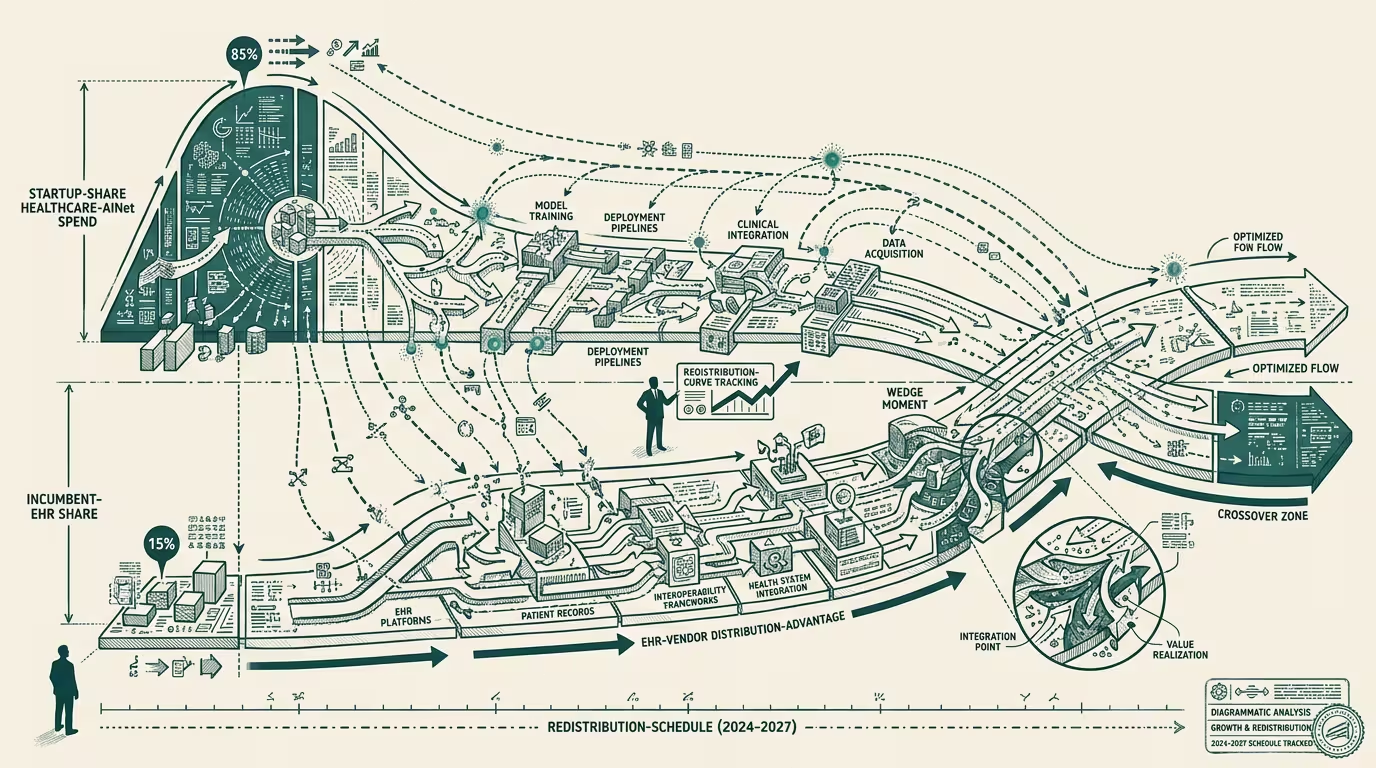
The "healthcare AI adopting at 2.2x the broader economy" headline ran across the trade press through Q3 2025. The Q4 disclosure that landed alongside it: 85% of healthcare AI spend flowing to startups rather than to incumbent EHR vendors. The combination read as a healthcare-AI growth story for the operator and venture class.
Two readings of the same numbers. The trade-press reading is growth-story. The structural reading is redistribution-schedule.
_Healthcare AI adoption isn't a growth story. It's a redistribution schedule._ The 2.2x ratio reflects a denominator effect (low prior penetration inflates any growth number). The 85% startup spend is a transient condition (operating at the frontier where incumbents haven't built yet). The capital will shift back to incumbents as today's frontier features become table stakes.
The mechanism that makes the schedule durable is the EHR-distribution advantage. Healthcare-AI buying decisions flow through procurement, IT, and clinical-leadership review. Each layer is calibrated to the existing EHR-vendor relationship. Epic, Oracle Health, Athenahealth, MEDITECH each have entrenched procurement gravity that startups cannot replicate at the contract layer. The startup wins on capability when the capability is ahead of what the EHR ships natively. The startup loses on distribution when the capability arrives in the EHR's native roadmap.
What's the schedule actually look like? The 85% startup spend is calibrated to today's frontier use cases, not to tomorrow's table stakes. Ambient scribes, AI-driven prior auth, AI-driven clinical decision support — each is currently a startup-led category. By 2027-2028 each will have native EHR-vendor versions shipping at parity or near-parity capability. The startup-class margin compresses; the EHR-class captures the rents. This isn't a hypothetical projection; it's the same arc that played out in 2018-2022 with point-of-care documentation tools (NoteSwift, M*Modal class) where startup pioneers got bought by Nuance/Microsoft and absorbed into the EHR-integrated offering. The arc repeats every 5-7 years in healthcare-AI categories.
The schedule is fastest in categories with the lowest workflow integration depth. Categories that operate as overlays (chatbot interfaces, basic-summary tools, marketing-class AI) compress fastest because the EHR vendors can ship native versions with minimal integration work. Categories that require deep workflow integration (longitudinal-data graphs, multi-EHR aggregation, specialized clinical-decision-support with regulatory validation) compress slower because the EHR vendor's native version requires capability the EHR's existing platform doesn't natively support. The redistribution schedule is therefore category-specific, and operators tracking the schedule should be calibrating exit timing to category-specific compression curves.
The window for healthcare-AI startups is narrower than the venture-class capital allocation suggests. Venture investors deploying capital at 2025-2026 valuations into healthcare-AI categories are pricing the 2.2x growth ratio as if it represents durable competitive advantage. The part that holds says the ratio represents a transient denominator effect plus a pre-table-stakes frontier window. Operators who recognize the narrowness should be running active exit processes through 2026-2027 rather than holding for category-leader-pricing. The category-leader-pricing scenario assumes the redistribution doesn't happen on schedule, which is the asymmetric bet against the structural reality.
The same redistribution-schedule pattern recurs across regulated-category AI deployments where there's a dominant incumbent platform: financial-services-AI (Fiserv, FIS playing the EHR-vendor role), government-AI (Tyler Technologies, NEOGOV class), insurance-AI (Guidewire, Duck Creek class). Each category has its own redistribution timeline, calibrated to the incumbent's native-feature development velocity and the buyer's procurement gravity. The healthcare-AI arc is one example; the pattern generalizes.
What's the structural read? The 2.2x growth ratio is a real number that loads no operator-class signal beyond the denominator effect, the 85% startup spend is a transient condition with a 2027-2028 expiration, and the discipline for healthcare-AI startups is to recognize the redistribution schedule and run exits accordingly. The venture press will continue to write the growth-story framing for another 18-24 months. The structural read will surface in 2027 when the first wave of healthcare-AI startup exits start landing at lower multiples than the early-stage prospectus modeled. By 2028 the structural shape is consensus.
Healthcare AI adoption isn't a growth story. It's a redistribution schedule. The schedule is operating-visible to anyone who reads the EHR-vendor roadmaps alongside the startup pitch decks. The investor class that prices the schedule into the multiple is the investor class operating-coherent against the structural reality. The investor class still pricing the growth ratio is the investor class absorbing the redistribution markdown when the schedule hits.
—TJ