Physician burnout is an org-design problem. The Canadian survey data makes the case.
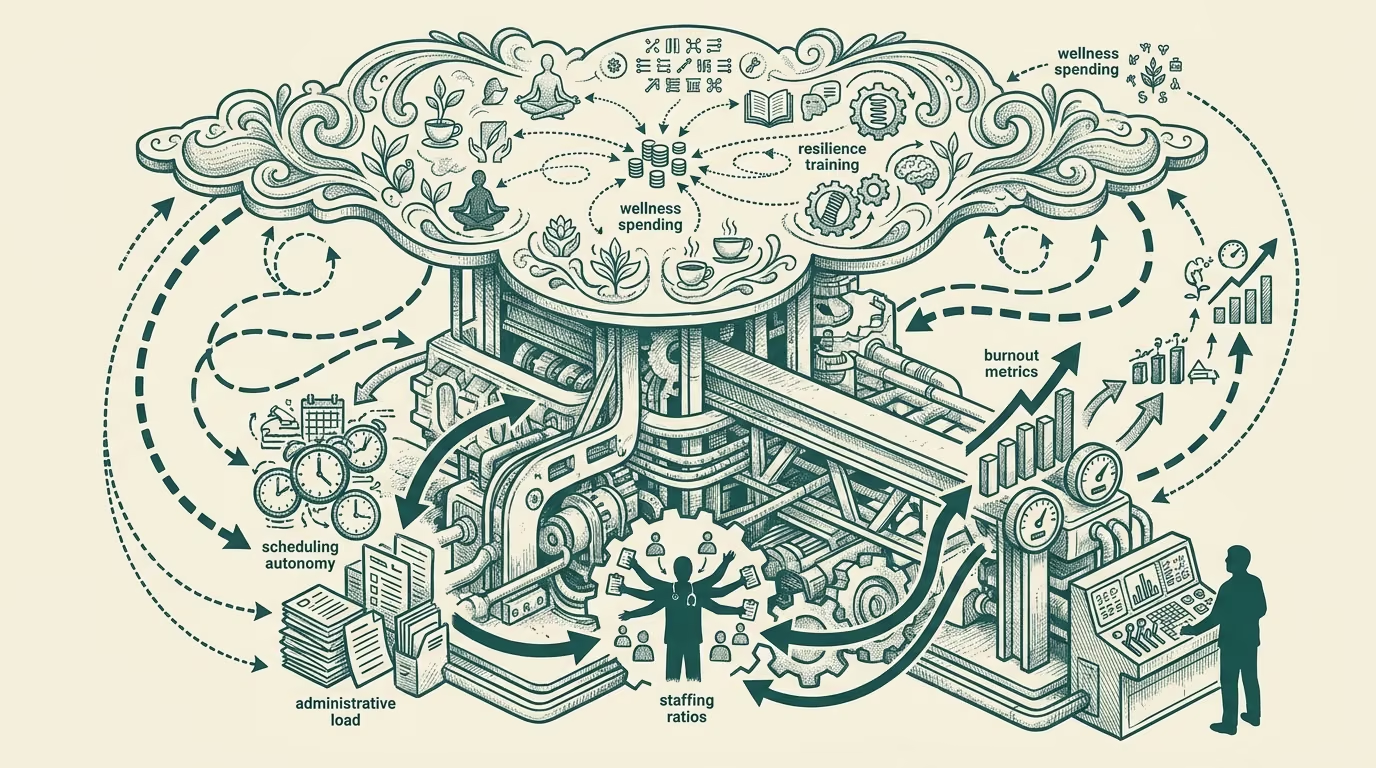
The Canadian Medical Association has run the National Physician Health Survey periodically since 2017, with the most recent broadly published cohort in 2021 and follow-up work through 2023-2024. The survey covers practicing physicians across Canada, with cross-sectional and longitudinal data on burnout-related metrics: emotional exhaustion, depersonalization, sense of personal accomplishment, intent-to-leave-the-profession, mental-health symptoms, suicidal ideation. The data has been remarkably consistent in shape across the survey rounds. Physician burnout in Canada is high, has been rising over the survey period, has not responded to the wellness-program-class interventions that have been the industry's primary response, and has demographic-and-organizational correlates that the data makes legible.
The Canadian data is more useful for the part that holds than the U.S. data is, partly because the Canadian cohort is more demographically homogeneous (which controls for some of the variance the U.S. multi-payer system introduces), partly because the survey methodology has been stable across rounds (which makes the longitudinal comparison cleaner), and partly because the Canadian healthcare system's structural shape (single-payer, provincial-administered) lets the data say more about the organizational variables than the U.S. data can.
This essay walks the data trajectory, the structural-vs-individual framing, three org-design changes that the data supports as effective, and the changes the wellness-program industry promotes despite the data showing limited effect.
What the data trajectory shows
The Canadian survey data through 2017-2023 shows three patterns the operator class should attend to.
The first pattern is that burnout prevalence among practicing physicians has been rising over the survey period, with the rise concentrated in the under-35 cohort and the family-medicine specialty. The directional trajectory is durable across the survey rounds. The wellness programs deployed at the major health authorities and provincial health systems through this period have not visibly bent the trajectory. The data does not say that wellness programs have no effect; the data says that whatever effect they have has not been large enough to outweigh the underlying upward pressure on burnout prevalence.
The second pattern is that burnout correlates strongly with organizational-level variables (administrative-burden hours, EHR-time-outside-clinical-hours, on-call density, locum-availability for relief, panel-size relative to clinic capacity) and weakly with individual-level variables (self-reported coping skills, exercise-and-sleep behavior, mindfulness-practice engagement). The strong correlation with organizational variables is the structural finding the wellness-program-industry framing has been generally not running.
The third pattern is intent-to-leave-the-profession, which the survey tracks as a separate construct. Intent-to-leave has risen alongside burnout but with a steeper slope, especially in the under-45 cohort. The implication is that the operational consequence of physician burnout is not stable distress; it is workforce departure on a timeline that the healthcare system's training-and-replacement infrastructure cannot match. The Canadian system has been losing physicians faster than it can train new ones for several years now, and the trajectory is downstream of the burnout trajectory.
Why the wellness-program framing is the wrong frame
The wellness-program industry treats burnout as a coping-and-resilience problem the individual physician can address through better self-care, mindfulness practice, peer-support programs, employee-assistance services. These interventions are widely deployed at Canadian health authorities and U.S. health systems, with substantial budget allocation and visible-leadership commitment.
The structural problem with the framing is that the data does not support it. The interventions have small effects on the individual-level variables that weakly correlate with burnout, and no measurable effect on the organizational-level variables that strongly correlate with it. The wellness programs are addressing the lower-leverage causes while leaving the higher-leverage causes unaddressed. The result is a steady budget allocation to interventions that produce small effects and a structural avoidance of the harder organizational-level work that would produce larger effects.
The reason the wellness-program framing persists is partly that the interventions are easier to deploy (the organizational-level work requires structural change to clinic operations, EHR configurations, and staffing models, which is expensive and slow), partly that the framing protects organizational leadership from the implication that their organizational decisions are causing the problem, and partly that the wellness-program industry has built a self-sustaining ecosystem of vendors, conferences, and certifications that creates visible activity even when the underlying outcomes do not move.
The Canadian data makes the case that this framing has been wrong since at least the 2017 baseline. The structural reading the data carefully should be advocating for the org-design framing instead.
Three org-design changes that the data supports
The first change the data supports is reducing administrative-burden hours. The strongest single correlate of burnout in the Canadian survey data is the number of weekly hours spent on EHR documentation, prior-authorization paperwork, and other clinical-administrative tasks outside the patient-facing clinical work. Health authorities and clinics that have invested in scribe support, EHR optimization, and prior-authorization-staffing have seen measurable reductions in administrative-burden hours and corresponding reductions in burnout prevalence. The investment is meaningful (typically a single-digit percentage of clinical operating budget) and the return on it is substantial in burnout-and-retention terms. The change is not glamorous; the change works.
The second change the data supports is panel-size-and-capacity rebalancing. Family-medicine practices in Canada have, on average, panel sizes that exceed the capacity of the practice's clinical infrastructure to serve well, with the gap absorbed by the practicing physician's after-hours work. The provinces that have invested in team-based-care models (with nurse practitioners, social workers, mental-health professionals integrated into the primary-care team) have rebalanced the panel-to-capacity ratio in a way that reduces the after-hours burden on the physician. The provincial-level data shows the team-based-care rollouts correlate with reduced burnout and improved retention in the family-medicine cohort. The rollout is multi-year and structurally complicated; the data nonetheless supports it.
The third change the data supports is on-call density redistribution. The on-call burden in many specialty practices is concentrated on a small number of senior physicians, with the concentration creating both the burnout pattern and the retention risk in the senior cohort. Practices that have redistributed the on-call burden across a broader physician pool, sometimes through cross-organizational coverage arrangements with neighboring practices or hospitals, have seen reductions in burnout prevalence among the previously over-burdened physicians. The redistribution requires negotiation and structural change; the data shows it works.
The changes the industry promotes that don't move the data
The first change the wellness-program industry promotes that does not show up in the survey data as effective is mindfulness-and-resilience training. Programs that train physicians in mindfulness practice, cognitive-behavioral resilience techniques, and similar individual-level coping strategies have small effects on individual-reported coping metrics and no measurable effect on burnout prevalence at the population level. The interventions are not harmful; they are not the high-leverage interventions the industry has positioned them as.
The second change the industry promotes that does not move the data is peer-support-and-mentoring programs at the institutional level. These programs match physicians with peer mentors or peer support groups for ongoing engagement around the emotional load of clinical practice. The programs have small effects on individual-reported support-seeking behavior and no measurable effect on burnout prevalence. The mismatch between the programs' positioning and their measurable effect is the same shape as the mindfulness-training mismatch.
The third change the industry promotes that does not move the data is the employee-assistance-program tier of support, which provides confidential individual counseling and referral services for physicians experiencing burnout symptoms. The utilization rates for these programs are low (typically below 5 percent of the eligible cohort), and even where utilized the programs do not appear in the survey data as a meaningful intervention. Again, not harmful, not high-leverage.
What the operator class should take from the data
For health-authority and health-system leadership reading the Canadian data carefully, the implication is that the substantial budget currently allocated to wellness-programs-and-individual-resilience interventions is producing small returns, and the substantial budget that would be required for the org-design changes the data supports is the harder allocation that would produce larger returns. The political-and-organizational difficulty of redirecting the budget is real; the argument that holds for redirecting it is also real.
The longer the budget continues flowing to the lower-leverage interventions, the longer the burnout trajectory stays on its current upward slope, and the longer the workforce-retention consequences continue to compound. The Canadian system has years of data on this and the data has not been ambiguous in any survey round. The framing has been the bottleneck. The framing is correctable. Treating burnout as the org-design problem the data shows it is, rather than the coping-and-resilience problem the wellness-program industry frames it as, is the operator-class lever that produces the durable population-level change. Operators who run the data and reallocate accordingly will produce the better workforce outcomes. Operators who continue with the framing the industry has been selling will continue to produce the same trajectory.
The Canadian data has made the case for several years. The operator class is, slowly, starting to read it. The transition from wellness-program-industry framing to org-design framing is incomplete, contested, and gradually moving in the right direction. The data should accelerate the transition. The trade-press should help. The structural argument is not in dispute among careful readers. The question is when the field-level practice catches up to it.
—TJ