The single-payer debate is over. The single-payer math hasn't changed.
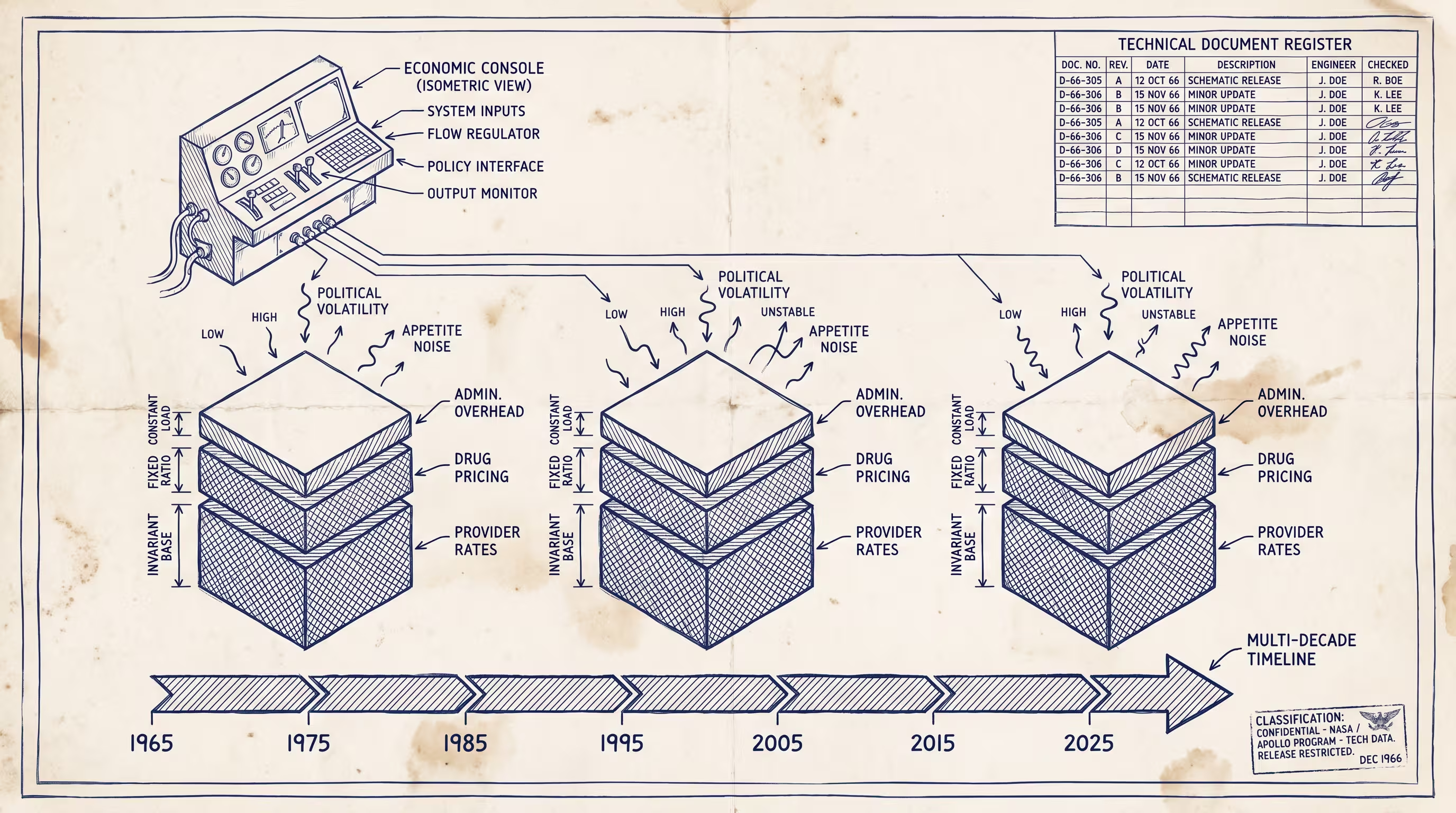
The single-payer debate, in any politically active sense, is over. The 2020 Democratic primary was the high-water mark; the 2024 cycle has not produced a serious candidate carrying the policy as a top-three priority, and the policy itself has receded from the agenda of every think tank and advocacy organization that pushed it from 2016 to 2020. This is a real political fact and it is worth naming clearly. The single-payer math, though, is the same math it was in 1993, and in 2009, and in 2017. The math has not moved.
The math, briefly: the United States spends roughly seventeen to eighteen percent of GDP on healthcare and achieves outcomes that, on any of the standard cross-country comparisons, place it in the bottom third of OECD-equivalent peers. The next-most-expensive country (Switzerland, Germany depending on the year) spends around twelve percent. The OECD median sits closer to ten. The arithmetic gap is six to eight points of GDP, which in 2024 dollars is roughly one-and-a-half to two trillion per year. That is not a marginal number. It is, in budgetary terms, larger than the entire annual defense budget. Whatever the political appetite for moving the system, the gap has been there, has grown modestly through the prior three decades, and shows no sign of closing under the current arrangement.
The thing the political conversation has consistently gotten wrong is the nature of the gap. The popular framing is that single-payer would close it through provider-rate compression: pay hospitals and physicians less, get the cost down. This is a real component (Medicare rates run roughly seventy to eighty percent of commercial rates depending on the procedure and the market) but it is not the largest component. The largest component is administrative overhead. The standard academic estimates put administrative load in the US system at roughly twenty-five to thirty percent of total spend, against eight to twelve percent in the comparison countries. That eight-to-eighteen-point gap is nearly the entire arithmetic difference. The cost of the US system is structurally a cost of negotiating between thousands of payers and tens of thousands of providers on a per-claim basis, with the negotiation infrastructure on both sides absorbing labor and software spend that does not exist in single-payer or all-payer systems.
This is the part of the math that does not change with political appetite. A multi-payer system, by its construction, requires the payment-negotiation infrastructure. The infrastructure costs what it costs. The cost will inevitably show up in some combination of premium, deductible, employer cost, and provider margin, and the total of those will sit at roughly the level it sits at now until the underlying structure changes. No amount of incremental reform (the ACA, Medicare Advantage growth, value-based care experiments, site-of- service shifting) addresses the per-claim negotiation cost as such. Each of those reforms has redistributed the cost across different parts of the system. None of them has compressed the administrative-overhead total to the comparison-country level, because none of them has changed the structural fact that there are still thousands of payers and tens of thousands of providers negotiating on a per-claim basis.
The piece I want to make is not the political argument. It is the narrower historical-inevitability point. The math has said, for three decades, that the US system carries roughly two trillion dollars a year of structural cost not present in peer systems. That number does not turn on which party holds the White House or how much energy advocacy is spending on it. It is a function of the per-claim-negotiation infrastructure, downstream of the multi-payer architecture. Whatever resolution US healthcare policy eventually reaches, in 2030 or 2040 or 2050, it will have to address the per-claim-negotiation cost. That is what the math is pointing at, and what the political conversation has mostly avoided naming directly.
The interesting question for the next decade, then, is not whether single-payer happens. It almost certainly does not happen. The interesting question is which partial-resolution structures, by other names, address the per-claim-negotiation cost. Possible candidates are all-payer rate-setting at the state level (Maryland has had a version of this for forty years, Vermont attempted one in the 2010s), aggressive consolidation of payment intermediaries (Optum, Evernorth, the larger PBMs effectively becoming the negotiation infrastructure), or a regulatory shift that compresses the per-claim cost by mandating standardized data exchange and prohibiting the kinds of friction that currently extract economic rent from the negotiation process. The Trump-era price-transparency regulations and the No Surprises Act are early-stage examples of the third path. None of them is the political-economy shape that single-payer carried. All of them are addressing the same arithmetic, by other names, because the arithmetic does not stop being true when the politics moves on.
The misdirection produced by the collapse of the political conversation is the operator-level point. When the appetite for single-payer drops off, the easy read is that the underlying question went away. It did not. It changed shape. The two trillion dollars a year of structural cost is still sitting in administrative overhead, in negotiation-infrastructure labor, in the software-and-services stack that exists only because the multi-payer architecture does. Whoever, over the next ten or twenty years, builds the layer that compresses that cost (regulation, consolidation, or technology) is going to capture or unwind a multi-trillion-dollar structural pool. The political conversation has stopped naming this. The math has not.
—TJ