The Sunday-night business-traveler segment is dead. Long live the Tuesday-Thursday segment.
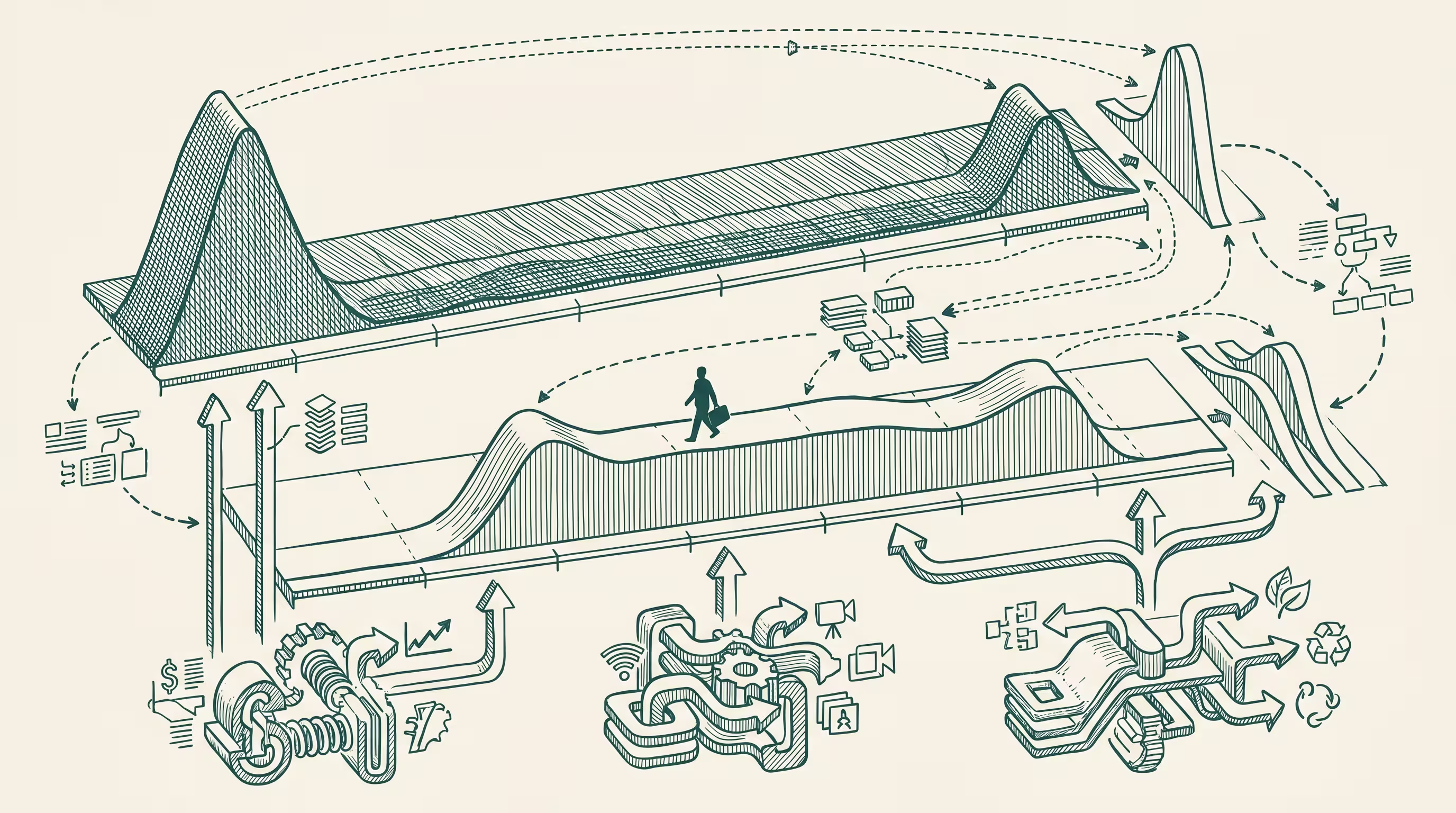
The shape of business travel changed permanently between 2020 and 2024. The Sunday-night fly-out for a Monday meeting is gone in any segment that is not a sales force operating against a Monday-morning customer slot, and the Sunday-night sales-force segment is itself thinning because most enterprise customers stopped taking Monday-morning meetings. The modal shape is now Tuesday-arrive Thursday-depart, and it is going to stay the modal shape because the drivers that pulled the trip into the new equilibrium are structural rather than pandemic-residual.
The drivers are three. The first is that the office-attendance pattern in the corporate-customer segment settled, in most industries, on a Tuesday-Wednesday-Thursday core with Monday and Friday as remote-default days. The customer the business traveler is going to visit is not at their office on Monday. There is no Monday meeting to fly to. The trip moved to mid-week to track the customer's mid-week presence, and the trip's anchor day became Wednesday rather than Monday.
The second driver is the rebuilt expense-policy regime. The post-2020 expense policies at most large corporates explicitly disfavored Sunday-night travel for cost reasons (Sunday hotels are not materially cheaper on the corporate-rate negotiation, but the extra night against the trip's productive output is hard to justify) and for what was sometimes called wellness reasons but was actually a recognition that the Sunday-night-out arrangement was producing a generation of mid-career employees who were burning out at a rate the firm could measure. The policies pushed the trip toward Tuesday-arrive. The traveler did not push back.
The third driver is the shift in what business meetings are for. Pre-2020, the in-person business meeting was the default work mode for any cross-organizational interaction of consequence. Post-2024, the in-person meeting is reserved for the interactions that are not well-served by video — the relationship-building one, the high-stakes negotiation, the on-site visit, the team off-site. Those interactions are scheduled. They do not happen on Monday morning because the people who are flying in to participate need Tuesday morning to land, settle, and prepare. The meeting calendar moved to Tuesday-Wednesday-Thursday because the work moved to Tuesday-Wednesday-Thursday.
The hotel implication
The hotel implication is that the high-rate days in the urban-business markets compressed from a five-day week into a three-day window, and the ADR (average daily rate) curve that the revenue-management systems had been pricing against was no longer the right curve. The systems that kept pricing Sunday and Monday as moderate-business-rate nights kept selling those nights at moderate-business-rate occupancy and watched the leisure traveler pick them up at the moderate-business rate, which is lower than the leisure-rate the property could have charged. Tuesday and Wednesday went the other direction: the demand curve compressed onto fewer nights, the same business travelers were competing for the same room inventory, and the right ADR for Tuesday and Wednesday in 2024 was materially higher than the system's training data was suggesting.
The hotels that moved fastest on the recalibration ran a price increase on Tuesday and Wednesday, sometimes substantial, paired with a price decrease on Sunday and Monday that targeted the leisure segment more aggressively. The hotels that did not move kept pricing the old curve and kept losing margin. This is a yield-management problem, not a strategy problem. The yield-management systems were trained on demand curves that no longer existed. The training-data lag is the operating problem.
The under-discussed second-order effect is the meeting-room and food-and-beverage attach. Tuesday-Wednesday business travelers buy more meeting room hours and more dinner covers than Sunday-Monday business travelers because the trip is shorter and the customer-facing work is denser. The hotels that recalibrated room rates without recalibrating meeting-room and F&B pricing left even more margin on the table. The hotels that recalibrated everything captured the largest share of the new equilibrium.
The airline implication
The airline implication is more complicated because the airline's planning cadence is longer and the schedule's flexibility is more constrained. The Sunday-night business-traveler segment was one of the highest-yielding segments on the major-hub routes, and it had a predictable shape: late-Sunday-evening departure, full-fare or near-full-fare, low elasticity on price, almost-zero refund rate. The airline yield-management systems were calibrated against this segment and against the parallel Friday-evening return-home segment. Both segments compressed.
What replaced them is a Monday-evening or Tuesday-morning business-traveler segment that is more price-elastic (the corporate has more days to plan, the policy now requires one quote-comparison cycle), more refund-prone (the customer-facing meeting can move on short notice), and more concentrated in shoulder hours rather than peak hours. The yield-management systems that kept pricing the Tuesday-morning departure as a moderate-business-rate slot and the Monday-evening departure as a near-peak slot got the calibration backwards. The Tuesday-morning business traveler is paying the higher fare. The Monday-evening business traveler is half-leisure now.
The schedule implication is that the airlines that adjusted their schedule density to match the new shape (more Tuesday-morning capacity from secondary cities into hub cities, less Sunday-evening capacity, more Thursday-evening return capacity, less Friday-evening return capacity) outperformed the airlines that kept the schedule fixed and tried to solve the problem with pricing alone. Schedule is the long lever. Pricing is the short lever. The airlines that pulled both got the largest share.
Why the new shape sticks
The case for why the new shape is permanent rests on the structural-driver argument: the customer's office attendance is not going back to a five-day pattern; the corporate expense-policy is not going to re-permit a Sunday-night out for routine travel; the meeting-mode shift to "in-person is for interactions that need it" is not reversing because the substitute (video) is good enough for the interactions that did not need it. The forecasting case for the old shape returning would require all three drivers to reverse, and there is no plausible policy or technology development that reverses all three.
What can change is the mix. A future in which the corporate office-attendance pattern moves to Monday-Tuesday-Wednesday (instead of Tuesday-Wednesday-Thursday) is plausible if firms decide the Friday-as-remote-default is too costly and re-anchor on Monday-as-required. The mix-shift would move the modal trip back by one day but would not reinstate the Sunday-night arrival. The trip stays mid-week. Only the boundaries shift.
The operator-level takeaway is that the segment that is now the modal segment is the highest-yielding segment, and the operators that priced for it earliest captured the most margin. The discourse about whether business travel is "back" was always asking the wrong question. Business travel is back, in different shape, at different volume, on different nights. The right question for the operator is whether the pricing model has been retrained against the new shape. The operators who answered yes are pricing the new equilibrium correctly. The operators who answered no are still subsidizing the leisure segment with under-priced Sunday-Monday nights and over-priced Friday-night returns, and they are going to keep losing margin until the retraining is done.
The Sunday-night business-traveler segment is dead. The operators who recognize what replaced it run the numbers correctly. The rest are still pricing for a customer who is not in the airport.
—TJ