The agent stack did not collapse. The wrong prediction collapsed. Salesforce has the receipt.
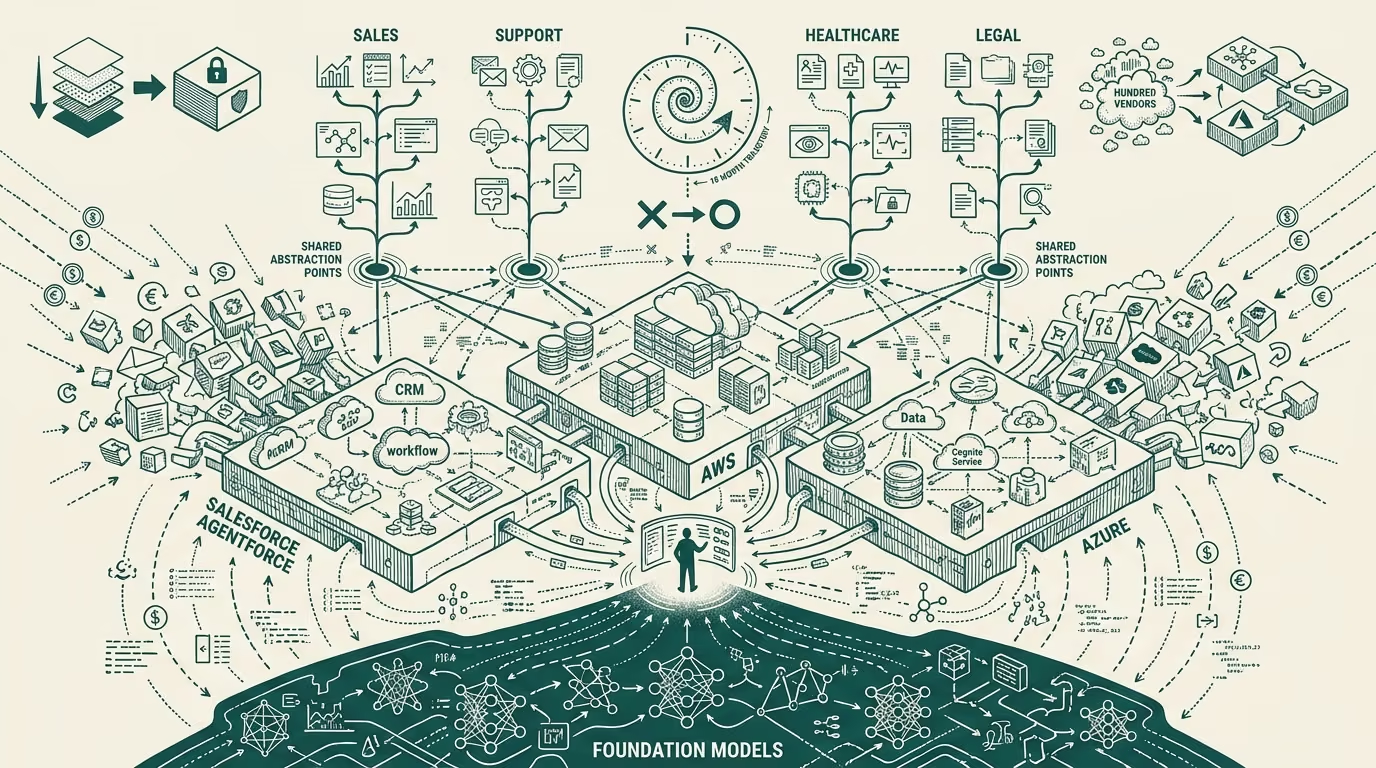
The 2023 consensus prediction on the agent-and-AI-tooling stack was that it would fragment. The argument went that the workflow surface for AI agents was so broad, the specialty use-cases so numerous, and the vertical depth required for each one so substantial, that hundreds of competing vendors would take specialty positions across the workflow, with no single platform consolidating the way the cloud platforms had. The 2023 conferences ran with this prediction. The 2023 venture-class deployment of capital ran with it, funding hundreds of agent-specialty startups across categories.
The 2024-2025 reality is that the agent stack consolidated around three or four major platforms faster than the cloud stack did. The cloud stack took ten years to settle into its three-pole shape (AWS, Azure, Google Cloud, with the long tail mostly absorbed or marginalized by 2018). The agent stack did the equivalent consolidation in eighteen months, with the Salesforce Agentforce launch in late 2024 as the visible inflection point.
The wrong prediction collapsed. The agent stack did not.
What the wrong prediction was
The 2023 prediction had three components. First, that no single foundation-model provider would dominate, which would push agent-tooling vendors toward multi-model abstractions that no single platform could control. Second, that vertical-specific agent applications (sales, support, healthcare, legal, engineering) would each require enough specialty knowledge that horizontal platforms could not address them. Third, that the deployment-and-integration work was sufficiently bespoke per-customer that platform-tier offerings could not capture enough operational consistency to drive the consolidation pattern.
Each of the three components was structurally plausible in 2023. Each turned out to be wrong on the timeline that mattered.
What actually happened
What actually happened is that the major SaaS platforms (Salesforce, Microsoft, ServiceNow, plus the major foundation-model providers' own institutional offerings) absorbed the agent-tooling stack into their existing customer-and-data-graph relationships. Salesforce launched Agentforce in late 2024 with deep Salesforce-data integration, immediate availability across the existing Salesforce-customer-base, and pricing that bundled the agent capability into the existing Salesforce contract structure. Microsoft did the equivalent through Copilot Studio and the broader M365 Copilot offerings. ServiceNow ran the same pattern in the IT-service-management domain. The major foundation-model providers (OpenAI, Anthropic, Google) ran their own enterprise-tier offerings that competed with the SaaS-platform absorption.
The result by late 2025 was that the agent-tooling spend at the enterprise tier was concentrated across roughly four pillars: Salesforce (and the related Agentforce ecosystem), Microsoft (and the Copilot ecosystem), ServiceNow, and the foundation-model providers' direct enterprise offerings. The hundreds of specialty startups that the 2023 prediction implied would dominate had been substantially absorbed, partnered into the major platforms, or marginalized to specialty-vertical positions that did not capture the platform-tier revenue.
Why the consolidation happened faster than the cloud stack's
The structural reason the consolidation happened in eighteen months instead of ten years is that the agent stack inherited the customer-and-data-graph relationships the SaaS platforms already had. The cloud-stack consolidation in 2008-2018 had to build the customer relationships from zero, which was a multi-year acquisition-and-integration cycle. The agent stack started the consolidation in 2023-2024 with Salesforce already owning the customer-and-data graph for sales-class workflows, Microsoft already owning the productivity-and-engineering workflow graph, and ServiceNow already owning the IT-and-operations workflow graph. The agent capability slotted on top of existing customer relationships, with the platform-tier vendors needing only to ship the integration to capture the spend.
The second structural reason is that the foundation-model layer commoditized faster than the cloud-compute layer commoditized. Cloud compute was a meaningful differentiator across the AWS-Azure-GCP poles for years, with each platform having distinct technical advantages on specific workloads. Foundation models commoditized within roughly twenty-four months of the 2023 capability surge, with the major customer-class workloads being roughly equivalent across the three or four leading models. The model-tier commoditization meant that the differentiator moved up the stack to the integration layer, where the SaaS platforms already had the structural advantage.
The third structural reason is that the regulatory and compliance demands of enterprise agent deployment favored the platform-tier vendors. The compliance-and-audit infrastructure the platform-tier vendors already had (SOC2, FedRAMP, HIPAA configurations, the major regional compliance certifications) was substantially harder for specialty startups to replicate. Enterprise buyers preferred the platform-tier offering because the compliance-and-audit work was already done.
The Salesforce receipt
Salesforce's Agentforce launch in late 2024 is the visible inflection point because the launch combined all three of the structural reasons in a single product release. The customer-and-data-graph relationship was already there. The model-tier abstraction allowed Agentforce to use multiple foundation models without committing to one. The compliance-and-audit infrastructure was inherited from the existing Salesforce platform. The pricing bundled the agent capability into the existing Salesforce contract, making the agent-tooling spend invisible as a separate line item.
The customers who had been evaluating multiple specialty agent vendors through 2023-2024 generally chose Agentforce when it launched, because the integration cost was lower (zero, effectively, for customers already on Salesforce) and the operational risk was lower (the existing Salesforce relationship covered the support-and-reliability concerns). The specialty agent vendors that had been pitching against the Salesforce-customer base lost most of those opportunities in the months following the Agentforce launch.
The Salesforce receipt is not the only one. Microsoft's Copilot Studio uptake through 2024-2025 ran a similar pattern. ServiceNow's agent offerings did. The foundation-model providers' enterprise tiers did. The pattern is consistent across the platform-tier vendors. The receipt that matters is that the consolidation happened across multiple platforms simultaneously, not that any single platform won.
What this implies for late entrants
For founders building in the agent-tooling category in 2025-2026, the consolidation pattern has several implications.
The platform-tier consolidation is largely complete for the horizontal workflow categories. Building a horizontal agent-tooling product against Salesforce, Microsoft, ServiceNow, or the foundation-model platforms is structurally difficult, and the founder-class advice is generally to either partner into one of the platforms or build for a specialty-vertical position that the platforms have not absorbed.
The specialty-vertical positions that survive are the ones with sufficient depth that the platform-tier offerings cannot serve them well. Healthcare-class agent applications with HIPAA and clinical-workflow specificity, legal-class agent applications with practice-area depth, regulatory-class agent applications with industry-specific compliance: these positions exist and have founder-class opportunities.
The integration-tier work that supports the platform consolidation is also a meaningful opportunity. Specialty integration vendors that help large enterprises connect their existing data infrastructure to the platform-tier agent offerings have a defensible position because the platforms cannot do the customer-specific integration work themselves.
The pure-horizontal late entrant is the position that does not work. The 2023 prediction assumed the late entrant would survive because the market would fragment and there would be room for hundreds of vendors. The market did not fragment. The late entrants pitching pure-horizontal agent products against the platform consolidation have not generally captured durable market positions.
The agent stack did not collapse. The wrong prediction collapsed. The operator class building in this space should plan against the consolidation that actually happened, not the fragmentation that the 2023 modeling expected. Salesforce has the receipt. The other platforms have receipts that look similar. The pattern is the pattern. Build for it, around it, or in the specialty positions it leaves open.
—TJ