The open-source agents will win the long tail. EU GPAI enforcement will accelerate it.
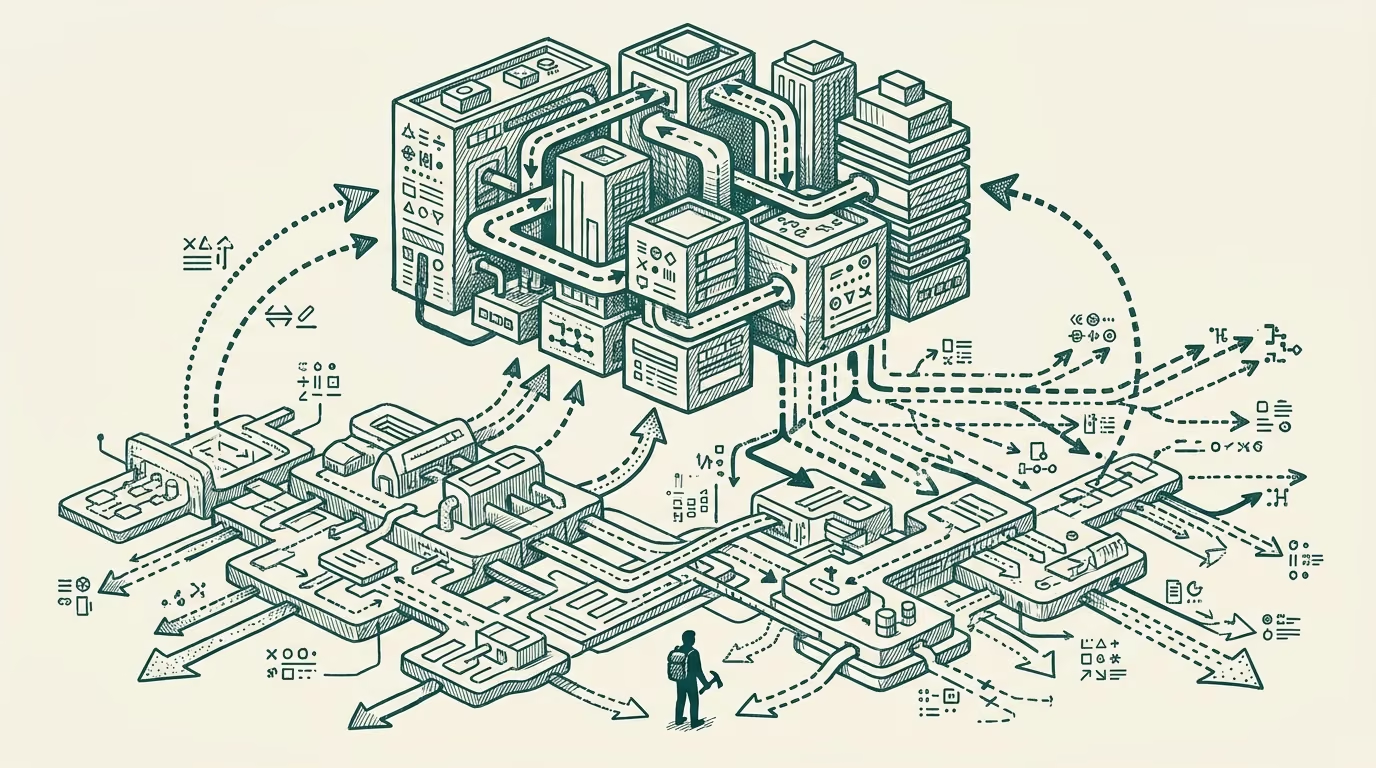
The agent-software market in late 2025 has split along a head-and-long-tail axis that the trade-press coverage has been generally not surfacing. The head of the market (customer-facing high-volume use cases, the major-platform integrations, the brand-name enterprise deployments) has concentrated at the foundation-model vendors discussed elsewhere. The long tail of use cases (boring back-office work, integration-tier products, specialty-vertical work, developer-driven internal tooling) has been splitting toward open-source agent frameworks. The split is not a temporary state; it is a stable shape that the next 24-36 months are likely to compound, with the EU GPAI Code of Practice enforcement beginning in mid-2026 accelerating the long-tail-to-open-source migration further.
This essay walks the head dynamics, the tail dynamics, and the regulatory accelerator. The forecast horizon is 2026-2028.
The head of the market
The customer-facing high-volume agent deployments (consumer-facing chatbots at major brands, enterprise customer-service automation at scale, the major-platform agent offerings discussed elsewhere) have concentrated at the foundation-model vendors and at the SaaS platforms that integrate the foundation-model offerings. The reasons are structural: the vendors with the foundation-model capability, the brand recognition that translates into procurement-class trust, the compliance-and-audit infrastructure that enterprise buyers require, and the capital base that supports continued capability investment have advantages that the open-source-only alternatives cannot match at the head of the market.
The head of the market is also the press-friendly half. The launch announcements, the case studies, the conference keynotes, the trade-press coverage all concentrate on this layer because it is the visible layer. The head will continue to grow through 2026-2028 as the major brands and major enterprises continue to deploy agent-software in their visible customer-facing and operational contexts.
The head is not where the volume of total agent-software deployments will end up living, however. The volume is in the long tail.
The long tail of the market
The long tail of agent-software use cases is substantially larger than the head by sheer count of deployments and by aggregate dollar impact, even though each individual deployment is smaller than the headline-class deployments at the head. The long tail includes: developer-driven internal tooling at companies that build their own agents on top of open-source frameworks; specialty-vertical work that does not justify the platform-tier vendor's enterprise pricing; integration-tier products that connect existing infrastructure to agent capabilities; the broad category of internal-process automation that companies build for their own operational use rather than purchase from vendors; the academic and research-class agent work that runs across thousands of universities and research organizations; the experimental-and-prototype work that developers run on their own time.
Each of these categories runs on agent infrastructure that the foundation-model vendors do not optimize for. The unit economics for the foundation-model vendors do not support serving the long tail at the platform-tier pricing the head requires. The buyer-class for the long tail (developers, internal IT teams, research-class organizations, specialty-vertical operators) prefers the open-source frameworks for control, customizability, and cost reasons.
The open-source agent frameworks (the LangChain ecosystem, the LlamaIndex tooling, the various model-context-protocol implementations, the AutoGen and CrewAI projects, the broader agent-framework category) have been progressively maturing through 2024-2025 with substantial community investment, growing documentation, and an increasing pool of developer talent that knows how to build with them.
The long-tail use cases, in aggregate, run at substantially higher deployment volume than the head. The economic value captured by the open-source frameworks is, in revenue terms, smaller than the value captured by the foundation-model vendors at the head. The economic value captured by the operators using the open-source frameworks (the companies, research organizations, developers building on them) is substantial and not flowing through the open-source projects' revenue lines because that is not how open-source economics work.
The split between the head (concentrated, foundation-model-vendor-served, press-friendly) and the long tail (distributed, open-source-served, less visible) is the durable shape of the agent-software market.
The EU GPAI accelerator
The EU GPAI Code of Practice, the implementing instrument under the AI Act for general-purpose AI models, begins active enforcement in mid-2026 with the various transparency, evaluation, copyright-compliance, and systemic-risk requirements progressively binding through 2026-2027. The compliance burden falls heavily on the foundation-model vendors and on the platform-tier deployments that operate at scale in EU markets.
The compliance burden is meaningful even for the largest foundation-model vendors. The cost is even more meaningful for smaller vendors and for vendors operating outside the EU who would otherwise serve EU customers. The combined effect is to push some categories of agent deployment away from the foundation-model-vendor channel and toward alternatives that absorb the compliance burden differently.
Open-source frameworks have a structural advantage in this regulatory environment. The compliance burden for an open-source framework is distributed across the ecosystem and the deploying party rather than concentrated at the vendor. The deploying party (the company building on the open-source framework, the developer running internal tooling, the research-class organization) absorbs the compliance work for their specific deployment, with the open-source community contributing the supporting tooling and documentation.
The result is that for some categories of long-tail deployment, the EU GPAI compliance trajectory makes the open-source alternative more attractive than the foundation-model-vendor alternative on a per-deployment-cost basis. The trajectory does not affect the head of the market (where the foundation-model vendors absorb the compliance cost as part of their platform-tier pricing) but does affect the long tail (where the buyers are price-sensitive and have the technical capability to manage their own compliance work).
What the split implies
For founders building agent-software products in 2026-2028, the operator-class read is to pick a side of the split intentionally. The foundation-model-vendor or platform-tier ecosystem is where the head-of-market opportunities are; the buyer is the enterprise-class organization with substantial procurement budget and compliance-class requirements that the platform absorbs. The open-source-framework ecosystem is where the long-tail opportunities are; the buyer is the developer-class or specialty-operator with technical capability and price-sensitivity that the open-source approach serves better.
The middle position (a proprietary commercial agent framework that competes with both the foundation-model platforms and the open-source ecosystem) has been progressively squeezed through 2024-2025 and is likely to continue compressing through 2026-2028. Vendors operating in the middle should evaluate whether to migrate up the stack toward platform-tier offerings or down toward open-source-aligned positioning.
For investors evaluating the agent-software category, the read is that the head-of-market valuations are concentrated at a small number of platform-tier companies, with the broader middle-tier vendor population structurally exposed. The open-source ecosystem produces less direct investment-class revenue but creates substantial value for adjacent categories (the cloud providers serving the open-source deployments, the specialty-tooling vendors that complement the open-source frameworks, the consulting-and-professional-services class that helps operators deploy them).
The split is the structural shape. The EU GPAI enforcement is the accelerator. The agent-software market in 2028 will look meaningfully different from the 2024 framing the venture-class consensus had been pricing. The head will be smaller and more concentrated; the long tail will be larger and more open-source. The trade press will catch up to this read on its own timeline; the operator-grade working in the space already sees the split and is positioning accordingly.
—TJ