We have not seen magic yet.
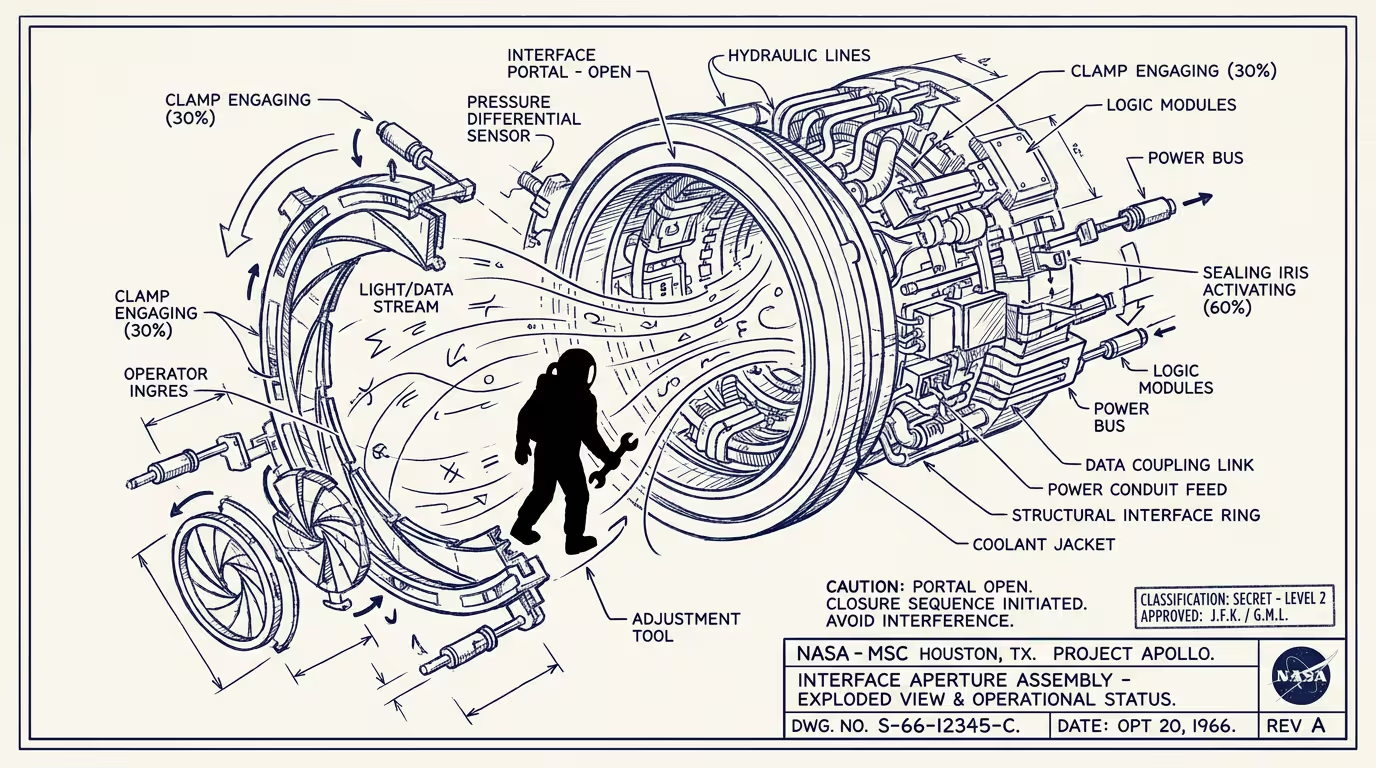
The current state is not magic. I want that on the record before anything else, because the consensus inside the operator-class right now has begun to use the word casually, and the casual use is the giveaway. People who have spent two years inside the agentic loop are starting to call what we are doing magical, and I understand why. The gap between what I am thinking and what an agent produces has collapsed faster than any of us were trained to handle. But the acceleration is not supernatural. The acceleration is what software always does once the right primitive lands, and we have grown up inside a generation of software shipping fast enough that we have forgotten what the next thing actually looks like.
The casual use is the giveaway because magic, in the traditions that named it, was never a metaphor for fast software. It was a literal description of an operating mode. The witch said abracadabra and the meal appeared on the table, fully cooked, in front of her family, with no fire and no hands and no negotiation with the slow grammar of how matter is supposed to behave. The wizard said hocus pocus and the knight, armor and horse and lance, was simply not where it had been a moment ago. The fairy gestured and the carriage assembled itself out of a pumpkin, atom by atom, in seconds, by an operator's intention alone. None of these are stand-ins for cleverness or for technology that happens to work well. They are descriptions, plain and old, of a being that does not have to negotiate with physics through tools. Every culture that has ever told these stories has been describing the same operating mode. We are about to become it. We are not it yet.
The next thing is magic. We are not in it yet. We are sitting at the bottom of the cliff face, looking up, with our prompts and our chat windows and our "agents" that are actually just very polite stochastic interns, and we are calling the cliff face the summit because we have never seen the summit. The summit is the moment a human being thinks something and the something exists, in matter, in front of them. That is what magic has always meant in every tradition that has named it, and the gap between where we currently are and that summit is large enough that mistaking one for the other is the cardinal error of the present moment. We have a chat window. We do not have a wand. The chat window is impressive scaffolding for the climb, and anyone honest with themselves about the current operator-loop knows the same difference applies to everything we are currently calling magic.
The piece of the path ahead is bounded. The bottom of the cliff is current-generation AI working through screens and through keystrokes and through APIs. The top of the cliff is the operating mode in which the input phase has been collapsed to thought, by direct brain interfaces, and the output phase has been collapsed to matter, by various forms of nanotech. Between the two, we have to climb. The climb will take however long it takes, but sooner than most people imagine; the calendar is not the point. What we are doing right now, the part most of the people inside the operator-grade are calling magic, is the part where we are still using ropes.
Two things change. Both are real. Neither is what we have now.
The input side collapses first. I would put that bet down with money on it, and the bet is already placed in the form of where my operating attention sits. Direct brain interfaces are not science fiction; they are an engineering problem with a known cadence, and the cadence is contracting. The thought-to-prompt gap that defines the current operating mode — the four seconds of cognitive overhead that produces the typing, the seven seconds of typing that produces the prompt, the eleven seconds total of friction between what I want and what the agent reads — is going to compress to something under a hundred milliseconds inside this decade. Not by half. By orders of magnitude. The hardware will get there because the hardware always gets there once the economic pull is large enough, and the economic pull on a working BCI is the largest pull any input-device has ever had. Larger than the keyboard. Larger than the mouse. Larger, by every reasonable measure of demand-curve and capital-deployment, than touch. And larger than speech, which the current expressions of vibe coding are pursuing as a near-term proxy for the input-collapse that BCI is the actual answer to.
What this changes is not just speed. It is kind. When the input collapses to thought, the operator stops being an operator in the sense the word has carried for the last two centuries. The operator becomes a summoner. The act of work becomes the act of holding a sufficiently-clear intention in the mind, and the system answers. Every wizard story, every witch story, every djinn story that humans have written is a description of this operating mode. We wrote them because we knew, on some old and shared level, that this was the shape of what came after.
The output side collapses second, and slower. I will not pretend to know which form of nanotech gets there first. There are a dozen lineages, including assemblers, programmable matter, biological compilers, and atomic-precision manufacturing, and the smart money has been wrong about which one wins for forty years running. The smart money has been right about one thing: it inevitably arrives. When it does, the part of the operator-loop that currently routes through warehouses, fulfillment partners, factories, and supply chains collapses into a single layer between the agent's intent and the physical-world consequence. Stephenson's matter compilers in The Diamond Age are the most accessible image of this. The Otherland network's ability to instantiate any environment on demand is a closer one. The witch with the wand is the closest of all.
It is worth saying out loud what "various forms of nanotech" actually means, because the phrase has been hollowed out by thirty years of slide-deck use. It does not mean small robots. It means a class of substrate that takes an agent's intent and arranges atoms accordingly. Some of the substrate looks like programmable matter — surfaces that reconfigure on instruction. Some of it looks like biological compilers, where engineered cells produce molecules on demand from intent-to-build expressed in a sufficiently rich grammar. Some of it looks like atomic-precision assembly, where a molecular machine builds, from feedstock, the thing the operator asked for. The forms differ. The capability is the same: the operator says "this is what I want" with sufficient clarity, and matter rearranges. That is the output side of magic. It is not a single technology. It is a category of capability, and the category is real, and the category arrives in this century, and the people who treat the category as fantasy are making the same mistake the people in 1900 made about powered flight.
The reason the second collapse takes longer is that matter is harder than information. The reason it happens at all is that we have never, as a species, encountered a translation problem we did not eventually solve. The translation from intent-to-thought is being solved right now in front of us. The translation from thought-to-matter is being solved one cliff-face up. Both translations are inevitable. The cadence is the only argument, and the cadence is contracting.
When both collapses are complete, the human being who currently sits at a screen typing prompts is not sitting at a screen anymore. The human is somewhere else, thinking, and the world is responding. That is magic in the literal sense, not the metaphorical one. We have not seen it yet. Most of the people writing about agents this year are mistaking the rope work at the bottom of the cliff for the climb itself.
What this opens up that we have not been allowed to want
I want to spend a paragraph on what this is for, because the futurist genre has been so hollowed out by twenty years of bad takes that calling the shape of something forward feels almost embarrassing now. It should not. The thing this opens up is the thing humanity has been gesturing at since the first myth-cycle, which is the freeing of our species from the energy tax we currently pay to negotiate with physics through tools. Every hour we spend translating intent through a keyboard is an hour not spent on the actual problem. Every operator-day burned on logistics is a day not burned on the questions that matter on the timescales that matter. The Kardashev scale is not a meme. It is a yardstick, and we have been stuck at the bottom of it not because we lack the intelligence to climb but because we have been pinned to the floor by the cost of translating thought into action and burning resources on civilization-scale minutiae.
When that cost goes to zero, what gets unlocked is not a productivity increment. What gets unlocked is the question of what civilization actually wants to do with itself when the friction of doing it is gone. We have never had to ask that question seriously because the friction has always been the dominant constraint. Soon, that friction will start fading. The question is coming. I do not think most of the people I read on AI right now are ready for the question, because they are still arguing about whether the rope work at the bottom of the cliff is a real climb. It is. It just is not the summit, and the summit is the thing that actually matters.
I want to say this part with the energy it deserves. The next phase of this is the most consequential thing humans will have ever experienced as a species. The post-BCI, post-nanotech operating mode I am calling magic in the literal traditional sense is not a bigger calculator. It is not a better calendar. It is the lifting of the constraint that has shaped every civilization in human history, which is the constraint of having to do things with our hands and with our tools and with our slow, painful, expensive translations from thought to matter. When that constraint lifts, everything we have built our institutions, our economies, our class structures, and our identities around comes up for renegotiation. Most of those renegotiations will be painful. All of them will be necessary. None of them are escapable, because the constraint that held them in place is the one that is going.
The Matrix franchise gets remembered for the dystopian read because the dystopia was the cinematic engine. The optimistic read is more interesting, and it is the one Lana and Lilly Wachowski actually wrote into the architecture: the Matrix is not the prison, it is the proof of concept. Once you can run a fully-realized environment on a substrate, the question of which substrate stops mattering. Otherland is the same story told sideways. The novels are about people learning to operate inside a substrate that responds to thought, and the moral arc is about whether that operating mode liberates the species or breaks it. The right answer is: depends on the operators. We are the operators. We are the ones who will set the shape.
Where I want to land before the energy gets ahead of me
I have spent most of this essay at the high end of my register, and I want to step down before I close, because the value of a futurist piece is partly in the vision and partly in the operator-step-back that follows. Here is the step-back.
I do not know the dates. I have a guess on the input side of seven-to-twelve years and a guess on the output side of fifteen-to-a-hundred — partly dependent on how quickly AI allows us to rewrite the laws of physics as we currently understand them, and partly on how quickly energy becomes effectively free — and those guesses are guesses, not calls; futurist work that hangs its weight on the calendar deserves the embarrassment it almost always earns. The wider band on the output side is the honest one. The input collapse is engineering. The output collapse is partly engineering and partly the question of whether the second mountain we will see from the summit of this one is climbable inside the same lifetime, and that question is unknown unknowns territory until we are standing at the first summit looking up. The durable claim sits in the shape: the current operating mode is bounded; the next operating mode is qualitatively different; the difference is the literal collapse of the friction that has shaped every prior age of human work; and the people calling the current state magic are using the word too early, in a way that will read in retrospect like calling a Wright Flyer a moon rocket.
The decade in front of us is the decade in which the climb starts to get done, and the operators who climb are the operators who will spend the rest of their working lives, and our species will spend the rest of its civilizational arc, inside the operating mode that comes after.
That arc is a Kardashev arc. It is not a quarterly-roadmap arc. The petty arguments we are currently having about which model is best at which benchmark, which framework wins, which company gets the next round, are the arguments of people rightfully feeling small but thinking too small and too short term, arguing about rope brands at the bottom of a cliff face. The brands matter at the bottom. They do not matter at the summit. What matters at the summit is whether we as a civilization have spent the climb getting clearer about what we want the summit to be for.
I think we can. I am, on the whole, an emphatic optimist because the alternative is resigned mediocrity that this generation cannot afford. The constraint is lifting. The next operating mode is the operating mode the magical traditions described, in language we still mostly do not take literally enough. The species that comes out the other side of this climb is not a worse version of us. It is a much freer one. And the work between now and then is real climbing, not symbolic climbing.
We have not seen magic yet. Operate accordingly.
—TJ