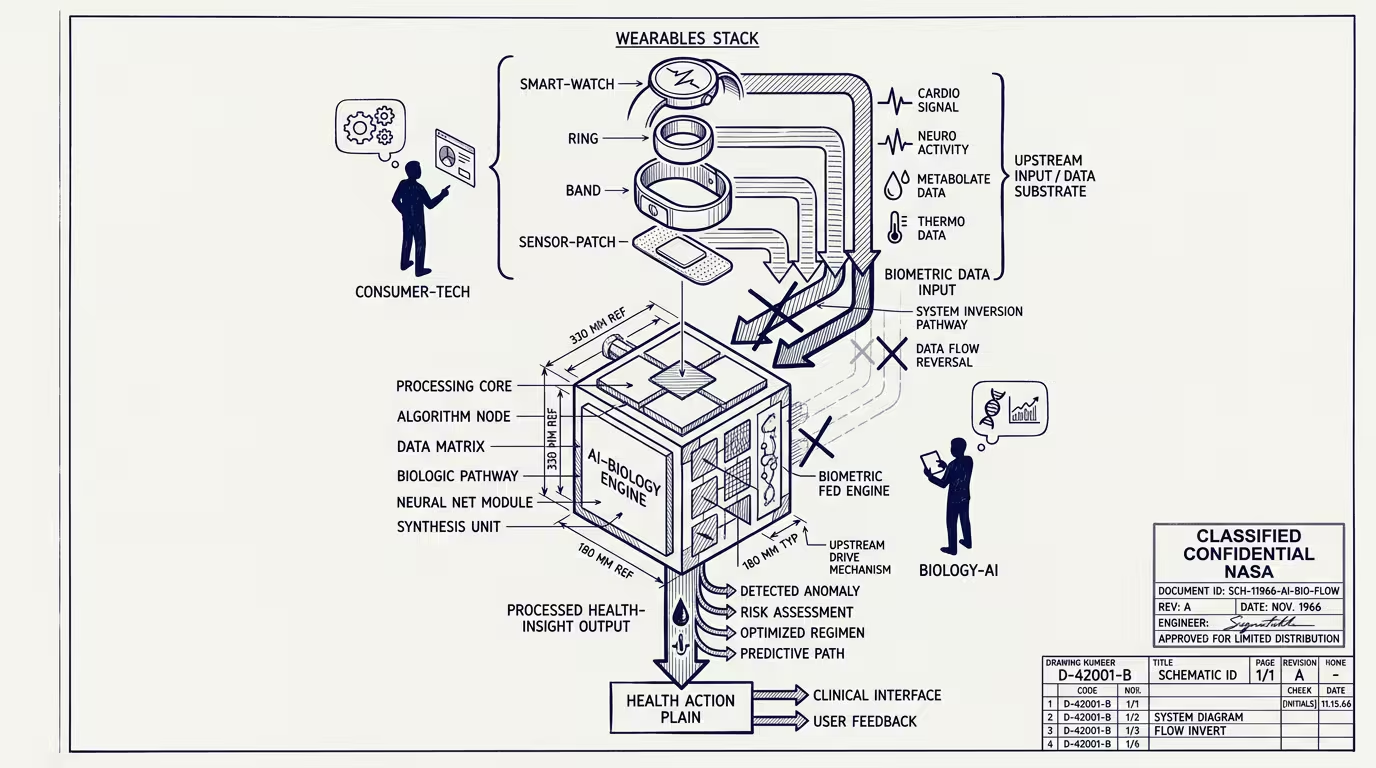
The wearables stack is now upstream of biology.
Peter Leyden's "Bio Age alongside AI Age" thesis circulated through specialist Substack circles in mid-2024. Amodei's "Machines of Loving Grace" brought the same read to mainstream discourse in October. The convergent argument: AI accelerates biological understanding on a curve steeper than the discipline has seen, and the next decade compounds breakthroughs across longevity, oncology, neuroscience, and metabolic disease.
The framing both essays share is _the model is the engine of biological insight_. The inversion neither essay quite says out loud is that _the wearables stack is upstream of the model_.
Hold that inversion in view. Everything that follows traces back to it.
What the wearables stack actually looks like in late 2024: Apple Watch with the third-generation health-sensing array. Whoop running 24/7 cardiovascular and recovery telemetry on its subscription model. Oura on sleep, HRV, temperature, and the metabolic-cycle data its subscriber base produces continuously. Levels and the broader continuous-glucose-monitor category at increasingly affordable price points. The Eight Sleep mattress capturing sleep architecture at higher fidelity than most clinical sleep studies. Plus a long tail of sport-specific wearables, neurological-monitor wearables, and the prescription-only continuous-monitor categories that ship through pharma.
The aggregate stack collects, at scale, the longitudinal biometric data that traditional clinical research never had access to. The clinical research model collected biometric data in laboratory studies, on selected populations, over windows of weeks or months. The wearables stack collects continuously, on the population that wears the device, over years. The dataset is structurally different. _The dataset is what the AI gets trained on next._
That last sentence is the load-bearing claim. The model's biological breakthroughs on the next-decade curve are downstream of what the wearables stack is collecting now. Whichever AI lab gets access to the wearables data graph, on terms that allow training, has a foundation-model-grade input the labs without that access don't have. The lab without the data trains on PubMed and clinical trial publications and ages on the data the wearables stack is producing. The lab with the data trains on the actual longitudinal biometric stream the human population is generating.
Trace that back to the wearables companies and the picture sharpens. Apple, Whoop, Oura, Levels, Eight Sleep all run consumer-electronics business models that price the device or the subscription, not the data. The data, on the AI-accelerates-biology curve Amodei is projecting, is worth materially more than the device-and-subscription revenue that produces it. The wearables company that pivots its commercial model to monetize the data layer in 2025-2026 is the company that captures the next decade. The company that keeps running the device-and-subscription model gets disrupted by the company that doesn't.
Trace it back to the frontier AI labs and the picture sharpens again. The labs are quietly negotiating data access with the wearables companies. This is not yet visible in the trade press in late 2024. It is happening at the BD-and-deals layer, on terms designed to preserve consumer-trust optics while transferring the longitudinal-data-graph rights. By 2026 the deals will start being announced. Early deals will be advantageous to the AI lab; later deals will be advantageous to the wearables company. The wearables company that signs early without a sophisticated data-rights structure will look, in 2030, like Sun Microsystems looked in 2010. The company that holds out and signs late will be the data-layer-platform-company of the AI-accelerates-biology era.
Trace it back to the patient cohort whose data is being collected and the regulatory exposure surfaces. The wearables EULA the consumer signed at activation is the same kind of marketing-grade terms-of-service that the de-identified-health-data-broker layer was operating under for two decades. The FTC's 2024 health-data rulemaking and the EU's continuing GDPR enforcement are going to scrutinize the consent layer for wearables data the same way they scrutinize the broker layer. The wearables company that hasn't pre-built an explicit-consent layer is going to be in the FTC's rulemaking the way the geolocation-data brokers were in 2023.
Each of those three lineages traces back to the same anchor — the wearables stack is upstream — and the thing that crosses pillars runs sharpest where two pillars meet. The wearable on the traveler's wrist is collecting biometric data during the trip that captures the body's response to flight, to time-zone shift, to the destination's environmental conditions, to the food and drink and stress and sleep of the trip. That data is, on the AI-accelerates-biology curve, foundational input to a class of personalized-travel-medicine products that does not yet exist. The travel insurance category is going to merge with the personal-health-monitoring category by 2027-2028, on the data graph the wearables stack is now producing.
That convergence is the substrate-shift this piece is naming. The wearables stack is not a consumer-electronics category anymore. It is the upstream sensor for a generation of healthcare products and a class of cross-pillar AI applications that the trade-press read mostly hasn't seen yet.
The cohort whose lived experience is being captured by the wearable is the cohort whose health data will, on the timeline Amodei is forecasting, become the training input for the AI that produces the breakthroughs the essay describes. The cohort did not consent to that on the terms the future framework will require. The wearables company that pre-built the explicit-consent layer in 2024-2025 ships into 2026 with regulatory clearance. The wearables company that didn't ships into 2026 with the same problem the data-broker layer is about to face.
The wearables stack is upstream of biology. The wearables stack is upstream of the AI. The wearables stack is upstream, in the next-decade frame, of the most consequential cross-pillar AI applications the next decade will produce. The operators who recognize this in 2024 are the operators running the data-layer of the next platform-tier company. The operators who treat wearables as consumer-electronics-with-health-features are the operators getting outflanked by the platform that didn't.
Wearables are not a category. They are the substrate. The operators who build for the substrate-shift are the operators who define the shape of the next decade's healthcare-AI category. The operators who don't are operating on a frame that already changed.
—TJ