What Medimap Was About to Become
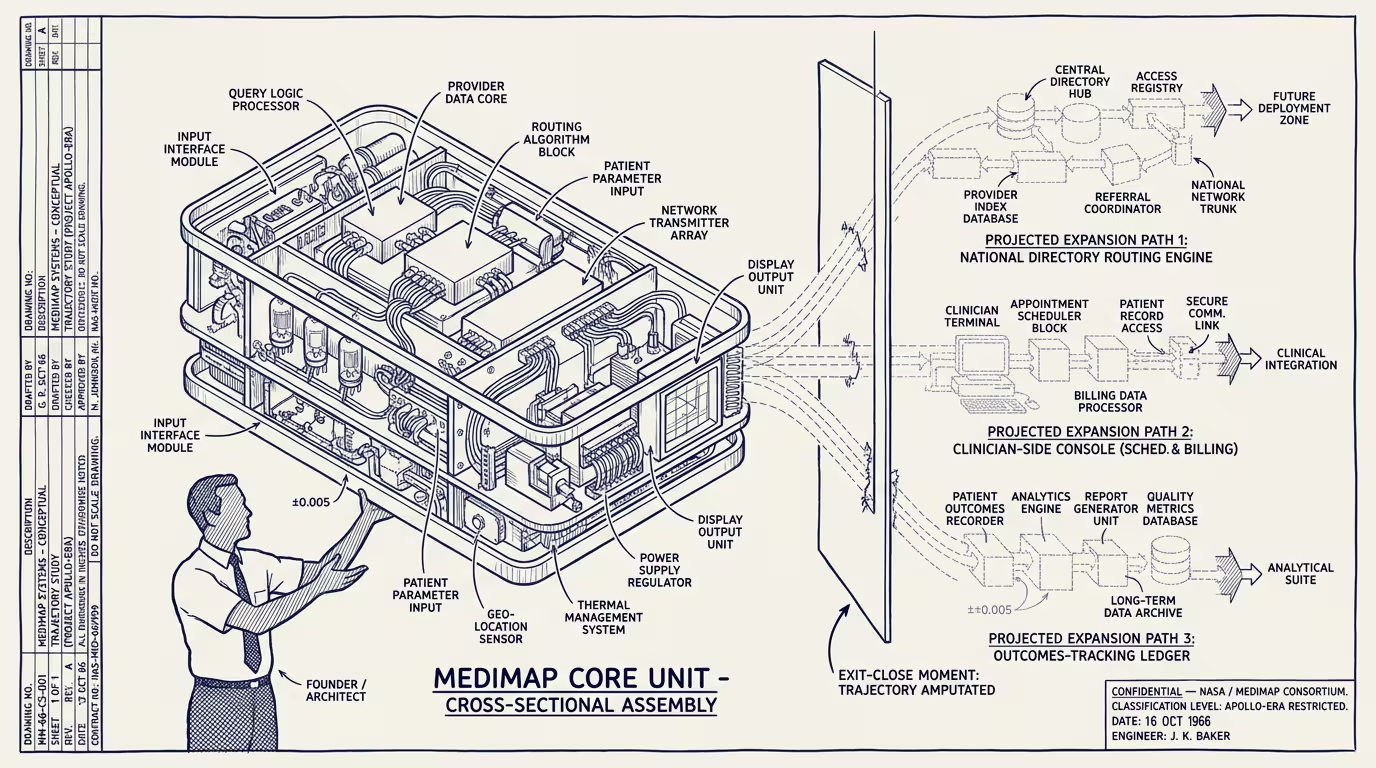
The thing you do not get to do, when an exit arrives, is finish.
You do not get to take the next pilot live in the next province. You do not get to see what the second cohort of nurses did with the routing layer once the first cohort had been on it for six months. You do not get to find out whether the partnership conversation that was warming up in the United States would have hardened into a signed pilot. You do not get to find out whether either of the two Canadian Global Innovation Cluster applications, which we had just put in motion to Digital Health and Scale AI, would have come back with a yes. You do not get to find out a lot of things, because the calendar of an exit is not the calendar of the work, and the two calendars rarely agree on what should have happened next.
Medimap exited. I want to write this piece carefully, because the company, and the people inside it, deserve carefully. The acquirer was the right kind of acquirer for the shape the company was in. Nobody got hurt. Nothing broke. Everything an exit is supposed to do, the exit did. And exits arrive the way exits arrive, which is rarely the way the work itself wants to arrive. I am writing this in late summer, looking at a list of things I had on my desk in the months before the close. The list is what makes me write. Not the close itself.
The shape Medimap had grown into
The thing about routing is that it only works at breadth. A routing layer that covers walk-in clinics is not a routing layer; it is a directory of walk-in clinics. A routing layer that covers walk-in clinics and pharmacies is a directory with two pages. The math of routing only starts to bite when the breadth is wide enough that the algorithm has real choices to make about which mode of care a given patient encounter should land in, and the only way to get the breadth wide enough is to spend years widening it, one care category at a time, in the order that the system itself permits widening to happen in.
By the spring before the close, the surface Medimap routed across had grown across most of the Canadian delivery system, in roughly the order anyone trying to solve the problem would have grown it in. Walk-in clinics first, because that was the entry point, and because the patient flow at walk-in clinics is the most legible part of the system to anyone trying to look at it from the outside. Then allied health: orthodontists, mental-health practitioners, chiropractors, physiotherapists, optometrists, dietitians, audiologists, each with their own scheduling shape and their own scope-of-practice rules, each routing differently from the one beside it. Then pharmacists, in the jurisdictions where their scope had been widened to cover real categories of patient encounter — Newfoundland's thirty-three minor ailments plus contraception, British Columbia's twenty-one ailments plus contraception under the MACS program, Ontario's nineteen ailments expanding toward thirty-three, Quebec's late-2024 PL-67 expansion. Every Canadian province has now authorized pharmacist prescribing for some scope of minor ailments, and the routing layer was beginning to take advantage of that scope in the provinces that had moved fastest. Then nurses, in the form that started with virtual visits and was beginning to widen into in-person community-care contexts. Then the first hospitals. Then dentists. Then whole health systems. Then general practitioners, which are the part of the system that gets the most attention in policy conversations and the least attention in routing infrastructure. At the close, the only category of healthcare provider we had not yet brought into the routing layer was specialists.
I am not writing that list to claim a victory. I am writing it because the breadth was the work, and because routing efficiently and effectively depends on breadth across the whole delivery system, and because I have not seen anyone else solving for that breadth fast or well. The category-by-category widening looks, in retrospect, like ambition. Inside the company, it never felt like ambition. It felt like the math of the problem. The routing layer needed all the categories to do the routing well, so we built toward all the categories.
That is the shape the company had grown into by the time the close arrived. The list of things on my desk in the months before the close was the next adjacent expansion of work already done, not the first surge of a company that had been small.
The list, more or less
The early data from the new categories was telling us something we had not yet had a chance to internalize. Nurses, especially virtual-visit nurses, were turning out to be the part of the system that actually had the throughput to absorb the routing work the algorithm wanted to do. Pharmacists, in jurisdictions where the scope-of-practice rules had been recently widened, were turning out to be the part of the system that could close the loop on a category of patient encounter that did not need to ever reach a clinician at all. We were one quarter into seeing how that wider operating posture played out, and the data was telling us we had been thinking too small. Not in a vague encouraging-data way. In a specific way: the routing decisions the algorithm was making, with the new categories included, were materially better than the routing decisions it had been making without them.
We had two pilots running with provincial governments. This was happening in the same window in which provincial primary-care attachment had become the most-funded line item in Canadian healthcare policy. Ontario had just put two-point-one billion dollars behind a Primary Care Action Plan whose stated target is every Ontarian connected to a primary-care team by 2029. British Columbia had stood up a Provincial Attachment System that the province was reporting as having attached more than two hundred thousand patients in its first sixteen months, even as third-party analysts were questioning whether the headline number was gross or net. Manitoba was rolling out MediNav, a centralized appointment-booking layer, and a digital health card. Seven of ten provinces had moved on centralized waiting lists in some form. The conversations Medimap was in had been going for long enough that by the spring before the close, both had reached the kind of state where the procurement people on the other side of the table were the ones doing the next step, not the policy people. That is the state that matters in healthcare procurement. Policy people can keep a conversation alive forever. Procurement people are the ones who actually move it. We also had a US partner lined up for a pilot. It was past the early-conversation phase and into the operational-detail phase. That is the phase where a deal is most often killed and also most often closed, depending on whether anyone wants to do the harder version of the conversation. We were doing the harder version of the conversation.
The routing algorithm was doing real work at the Winnipeg Regional Health Authority, thanks to the beyond-amazing team of believers there. Real work meaning not theatre. Not a demo. Not a dashboard with green lights on it for board meetings. Actual patients were getting routed away from defaults that were wrong for them, into options that were correct for them. Away from the the hours-long ER wait, the call into a voicemail tree. Faster, cheaper, more available, more appropriate. WRHA's own annual report for the period tells the macro version of the story: outreach attachment wait times that had stood at eight to ten weeks in 2023 had been reduced to under a week by the end of the cycle, and tens of thousands of unattached individuals had been matched with primary-care providers across that interval. The routing layer was one input into that aggregate, not the only one. The macro signal in the WRHA data was that the system as a whole was load-balancing, ever so slightly, in the direction it should have always been load-balancing. Toward the cheaper modes of care. Toward the more accessible modes of care. Toward the modes of care that match patients with what they actually need rather than what they happen to find first. All while maintaining the same quality of care, and freeing up doctors to get slightly faster to more urgent cases.
The two internal pilots, the ones we had not broadcasted to the world yet, were the ones that made the quietest noise but that I think about the most.
The Primary Doctor Waiting List pilot was matching unattached patients to family physicians faster than the provincial programs were doing the same job, at a fraction of the program cost. Not theoretically. In running production. The list of patients who had been waiting two years for a family physician at the start of the program had been measurably shortened by the routing pass at the end of the first quarter. The match rate was not magic. It was a routing problem the provincial program was trying to solve with intake forms and a queue, and that we were solving with the routing layer plus the breadth surface plus a small amount of operating discipline about which patients went to which physicians and why. The provincial-program comparison mattered because the provincial programs were not failing for lack of funding. Ontario's Health Care Connect waitlist had been reduced by more than 177,000 individuals, over three quarters of the prior list, under the new Action Plan since the start of 2025, and the cost of that reduction was visible in the budget. We were doing the same kind of work at a different unit economics (while also biting away at some of the backlog of that 177K number). Both kinds of work are needed. The routing-layer kind is the part the system has historically not built.
The Virtual Nurse Visit program was the second one. It was visibly redirecting patients away from the busy walk-in or the ER they would have otherwise defaulted to, and into a fifteen-minute virtual encounter that resolved the issue, escalated cleanly when escalation was warranted, and produced a documented care record that flowed downstream. The most interesting part of the data was not the cost-per-encounter, which was favorable in the obvious ways, but the escalation pattern. Encounters were escalating to the right next-level of care at the right rate. That is a harder thing to get right than it sounds, and we were getting it right.
Both of these pilots were small. Both of them were stable. Both of them were starting to show the pattern that mattered: that when the routing layer works, the system spends less, the patient gets seen faster, and the clinician at the top of the pyramid is the one doing the work only the clinician at the top of the pyramid can do.
We were on the Nvidia Inception track and the AWS Healthcare track. Both. Properly, where the partner managers on the other side knew our name, knew the routing problem we were solving, knew which province we were live in, and were the ones following up between calls instead of waiting for us to. The Nvidia conversation in particular had moved into the kind of phase where the discussion was about which of their reference architectures the routing layer most naturally extended, and that is the phase where partner-track membership starts to turn into actual joint-go-to-market motion. Getting into the AWS Healthcare track was perhaps even more meaningful. Not only because we were the only Canadian healthtech start-up that got in, but because it meant immediate help with credits, which are more than a lifeline.
The first cohort of nurses on the routing layer had been on it for long enough that we were starting to see the second-order effect — not just patients getting routed correctly, but the nurses themselves making different decisions about which patients to take into their queue and which to escalate, because the routing layer was changing what they could see about the rest of the system. That is the kind of effect that takes six months to even appear and another six to characterize. We had the first six. The second six did not happen at Medimap.
I wonder if that exit didn't happen a bit too soon.
The list looks like next-step. Not finish-line.
The pattern, which is older than Medimap
I keep coming back to routing. The Medimap pilots were the first time I saw, in production, what happens when the routing layer works at the scale of a province-sized population. The load-balancing problem in healthcare is not a theoretical problem and not a policy problem. It is a routing problem. The infrastructure for solving it exists. The will to deploy that infrastructure at the system level is the part that has been missing. The pattern is clearer from a year and a half of distance than it was inside the pilots.
The seams are still there. The seams are everywhere. A patient walks into an ER for a problem that a virtual nurse could have resolved in fifteen minutes — a category of encounter that programs like Rocket Doctor have now diverted by the thousand under OHIP, with a single ED-diversion pilot reporting more than three thousand avoided ER visits and over a million dollars in saved acute-care spend across two and a half years. A patient sits on a waiting list for a primary-care doctor for two years when a routing algorithm could have matched them in two weeks; the provinces are spending billions on intake-form-and-queue versions of the same matching problem. A pharmacist who is licensed to handle a category of encounter watches the patient walk past their counter and into the urgent-care clinic across the parking lot, because nobody told the patient that the pharmacist was an option, even though that pharmacist is now licensed to prescribe for that exact encounter under the province's expanded scope. These seams are not exotic. They are not edge cases. They are the modal experience of trying to use the Canadian healthcare system in 2025. The Medimap pilots were starting to show what happens when even one of those seams gets closed. There are dozens more.
The close
Looking at the list, I have to be honest about what it represents. It is not a counterfactual. It is a description of the state of the work at the moment the work changed hands. The branches that would have followed from that state did not get to follow. The work continues, because the work always continues, but it continues in a different shape and at a different company and with a different cap table. That is fine. That is how work works.
The seams are still there. I notice them more, not less. Whatever I do next will be in this shape.
I can imagine where that could've gone. The receipts were specific enough.