Why I won't fly Spirit again.
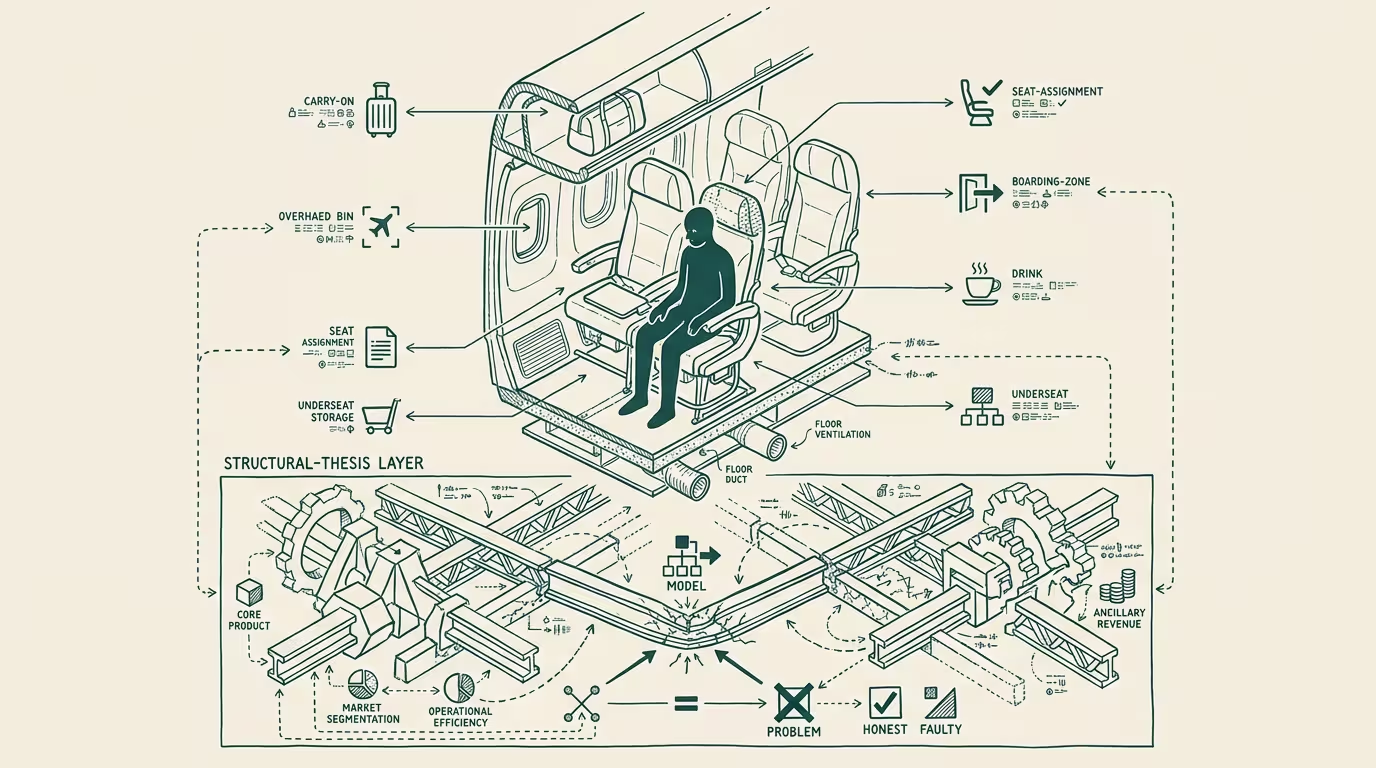
I flew Spirit on a Tuesday morning out of Fort Lauderdale last week and the flight was on time, the staff were professional, the seat was the seat I paid for, and the unbundling worked exactly as advertised. The base fare was honest. The fees for the carry-on, the seat assignment, and the boarding-zone upgrade were posted clearly at booking and again at check-in. Nothing about the experience was a surprise. Everything about the model is operating cleanly. I will not fly the carrier again.
The reason has nothing to do with the things people complain about. None of the fees felt like ambush fees. Seat pitch was tight in the way the marketing told me it would be tight. Crew were, in my limited sample, more professional than the legacy-carrier average. On-time arrival was earlier than the booked arrival. By every operational metric the airline tracks and reports, the flight was a success. The reason I will not be back is that the math the model rests on has stopped working, and the trip surfaced the math in a way the spreadsheet does not.
The math is the spread between the base fare and the legacy carriers' basic-economy product. Spirit's pitch, since the early 2010s, has been that the unbundled fare lets the price-sensitive traveler buy only the seat and pay separately for the things the legacy carriers used to bundle. The pitch worked when the spread was real: a forty-nine-dollar Spirit seat against a one-hundred-and-thirty-nine-dollar legacy seat was a different conversation than today's spread. American, Delta, and United have spent the last six years matching the unbundling at the bottom of their fare ladders. The legacy basic-economy product is not the same product as the legacy economy product. It is a Spirit-shaped product sitting on a Spirit-shaped fare with a Spirit-shaped luggage policy, sold by a carrier that also operates a network and a frequent-flier program and a credit-card business and an irregular-operations recovery posture that is materially better than the carrier I just flew. The spread that justified the original pitch is no longer the spread.
What I paid for the Tuesday morning flight, all-in, was within fifteen dollars of what American would have charged me for basic economy on a comparable schedule. The seat was the seat. The schedule was the schedule. The carrier was Spirit. There was no reason to choose Spirit other than habit and a vague sense that the bottom of the fare ladder is where I am supposed to look. That vague sense is wrong on this segment. It is also what the model used to win on, and the model has lost the win without the brand having absorbed the loss yet.
The deeper part that holds is that the unit economics of the Spirit fleet were never going to absorb a sustained period of fuel-price discipline plus elevated rates plus the slow legacy-carrier match-down on basic economy. The model was always living on the spread. When the spread compresses, the carrier has two choices: raise the base fare and lose the marketing claim, or hold the base fare and lose the operating margin. The carrier has spent the last two years doing both at different points in the same quarter. Reported losses are large enough that the obvious next move is fleet rationalization, route consolidation, and a financing event of one kind or another. Some of those moves have been signaled and others have not. The signaling itself is the tell.
What the model needs to survive is something the model is structurally unable to do. It needs the legacy carriers to back off the bottom of the fare ladder and concede the segment, which is not happening. It needs the fuel and rates environment to normalize into a window where the unit-cost spread re-opens, which is not under the carrier's control and is not the consensus forecast. It needs the brand to retain pricing power on the unbundled fees while the base fare moves up, which is the opposite of how the brand was built. None of those three is impossible. The combination of all three on a timeline that matches the carrier's debt schedule is not an outcome any reasonable person is forecasting from where the data sits in April 2024.
The read that survives from the seat is that I had a fine flight on a carrier that is running out of road. Crew did their job. Aircraft was clean. Schedule held. None of those things are what determines whether I book the carrier again three months from now. What determines that is whether the math works at the price I am being quoted, and the math has stopped working at the price I am being quoted, and the carrier cannot fix the math without becoming a different carrier. The version of Spirit that wins my booking three months from now is a version of Spirit that does not exist yet and possibly cannot exist given the cost base it is starting from.
There is a version of this commentary that reads as a takedown of the carrier and the people who run it. That version would be cheap and would also be wrong. People running Spirit have been running it competently against a category problem the category did not create. Unbundling worked. Execution is fine. Category is the issue. The lesson for any operator watching the segment is that a cost-leader strategy in a commoditized segment depends on the cost gap remaining a real gap, and once the gap closes the strategy does not have a second act ready to deploy. Spirit did not have a second act ready to deploy because the first act was the brand, the brand was the cost gap, and the cost gap is not what it was. That is a structural observation, not a moral one.
Writing this from the seat in April 2024, rather than waiting for the financial-press version, is the point. The financial-press version will arrive in its own time and will frame the story as a management failure or a market shock, and most of the framing will miss the fact that the failure was already visible from the seat. Base fare was honest. Fees were not surprises. Operations were clean. The carrier still cannot win at the price it has to charge, and a passenger who paid attention could feel that on a routine Tuesday morning out of Fort Lauderdale before any of the financial-press story had to be written.
Next time I am pricing a domestic segment at the bottom of the fare ladder, I will book the legacy basic-economy product. Seat will be the same shape. Price will be the same money. Carrier behind the seat will be one that has a network, a recovery posture, and a balance sheet that can survive the next bad quarter. That is the choice the model used to take off the table for me, and the model has put the choice back on the table without the brand having noticed.
—TJ