Founder Mode, Chesky version. Airbnb is the receipt.
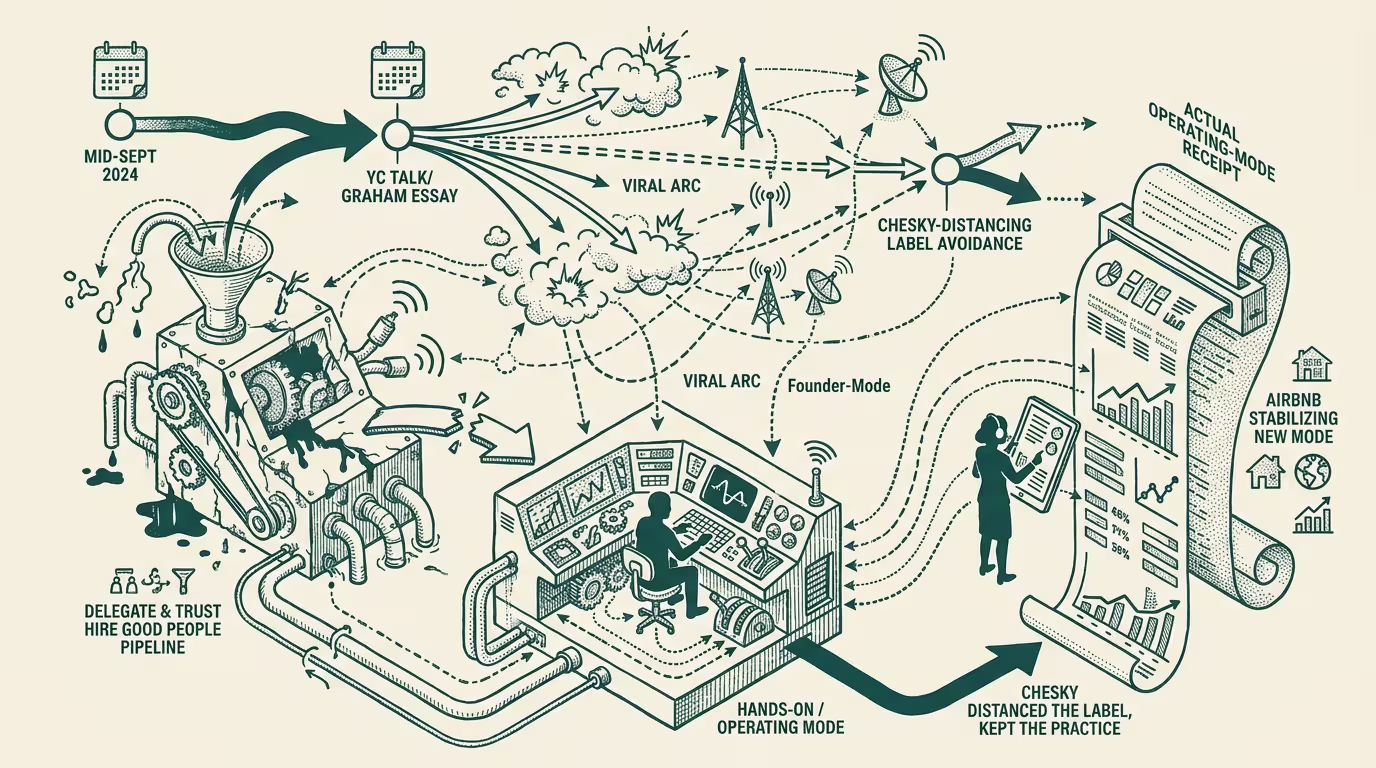
Brian Chesky's YC talk in mid-September 2024 was the load-bearing artifact. The talk described how Chesky, after a decade of Airbnb growth, had been told by every VC and management consultant in his network to "hire good people and give them room." He had tried that. The company had nearly broken. He had pulled back into a Steve-Jobs-class hands-on operating mode, started skipping levels, started leading product reviews two layers below where the management-class playbook said the CEO should sit. The company had recovered.
Paul Graham wrote "Founder Mode" the next week, naming the operating mode Chesky had described, and the term went viral inside seventy-two hours. Within ten days Chesky was distancing from the term: _"I never called it Founder Mode."_ He was not arguing with Graham's read of the talk. He was arguing with what the term had become in the discourse, which was a permission slip for any founder who wanted to micromanage their team without learning to delegate.
Chesky was right to distance. The term had been hijacked. The Airbnb operating model is the more interesting evidence than the Founder Mode framing.
What does the Airbnb Q3-Q4 2024 receipt actually look like?
Three datapoints.
Margin compounding.Airbnb Q3 2024 net income margin: 37%. The asset-light platform was outperforming the asset-heavy hotel chains on margin by a meaningful gap. Marriott Q3 2024 net income margin: about 13%. Hilton: about 11%. Royal Caribbean's premium brand: 21%. Airbnb was, by Q3 2024, running the most margin-efficient business in travel. The margin was structurally enabled by the platform model, but the _delta_ over the next-most-margin-efficient travel platforms was operator-driven.
AI strategy as fourth pillar. Late 2024 Airbnb publicly named AI as the company's fourth strategic pillar (alongside core, global expansion, Experiences). The naming was a Chesky-class operating decision. The execution had AI handling 33% of North American support without human agents by Q4 2024. The post-training was on 500M reviews and 1M support interactions — proprietary data the rest of the OTA category couldn't match. The strategic move was a CEO-level call. The execution was a year-and-a-half ahead of the rest of the category.
Support resolution speed.Airbnb's customer-support resolution times through 2024 trended down on the same operating-mode shift. The platform that had, in 2022, been routinely panned for support-quality issues was, by Q4 2024, posting the fastest median resolution times of any major travel platform. The improvement traced to Chesky-led product reviews of the support workflow, the AI-assisted-agent deployment, and the explicit operator commitment to support-quality as a strategic priority rather than a cost center.
Three datapoints, all attributable to a CEO-level operating-mode shift, all visible in the public-company Q3-Q4 financials. The receipt is in the financials.
The lesson the operator-class should take from this is sharper than the Founder Mode discourse made it.
The lesson is _not_ "every founder should run their company in Founder Mode." The lesson is that _the operating mode that fits the company's stage and the founder's skill should be chosen explicitly_, not defaulted to the management-class playbook because the management-class playbook is what the consulting-and-VC ecosystem sells. Chesky chose hands-on. The choice fit the moment Airbnb was in (recovering from a near-break, rebuilding around a strategic AI bet, repairing a support quality gap). The choice was the operator's, not the consultant's.
A founder running a different company in a different stage might choose Manager Mode and get a different receipt. A founder running a third company might run a hybrid that doesn't have a name. The point is the explicit choice. The implicit-default behavior is what the term Founder Mode was, briefly, trying to push back against.
thing that crosses pillars: the same operating-mode question applies across pillars, and the right answer in any given pillar depends on the company's strategic position rather than on the operator-Twitter-of-the-month framing. A healthtech CEO running a regulated-medical-device company probably needs more Manager Mode than Chesky needed at Airbnb. A futurist-AI-startup CEO probably needs more Founder Mode than the median tech company needs. The frame is the same in every pillar: choose the mode explicitly, calibrate to the stage, watch for the receipt in the financials.
Airbnb is the receipt that says the choice matters. Chesky chose hands-on. The financials line up. Whether other founders should choose the same mode is the wrong question; the right question is whether they're choosing at all, or whether they're defaulting to the playbook the consulting class wrote for a different operating context.
The Founder Mode discourse went viral and outran the argument. Chesky's walkback was right; the term had become a permission slip for the bad version of the operating mode. The Airbnb Q3-Q4 receipt is the load-bearing evidence the discourse should have been talking about, and mostly wasn't. The trade press, of course, will write the next round of operating-mode discourse the same way it wrote the Founder Mode round. The receipt is in the financials. The financials are public. The operators who read the financials beat the operators who read the discourse.
—TJ