The hotel category is broken in a way the airlines are not. Airbnb's AI fourth pillar is the divergence signal.
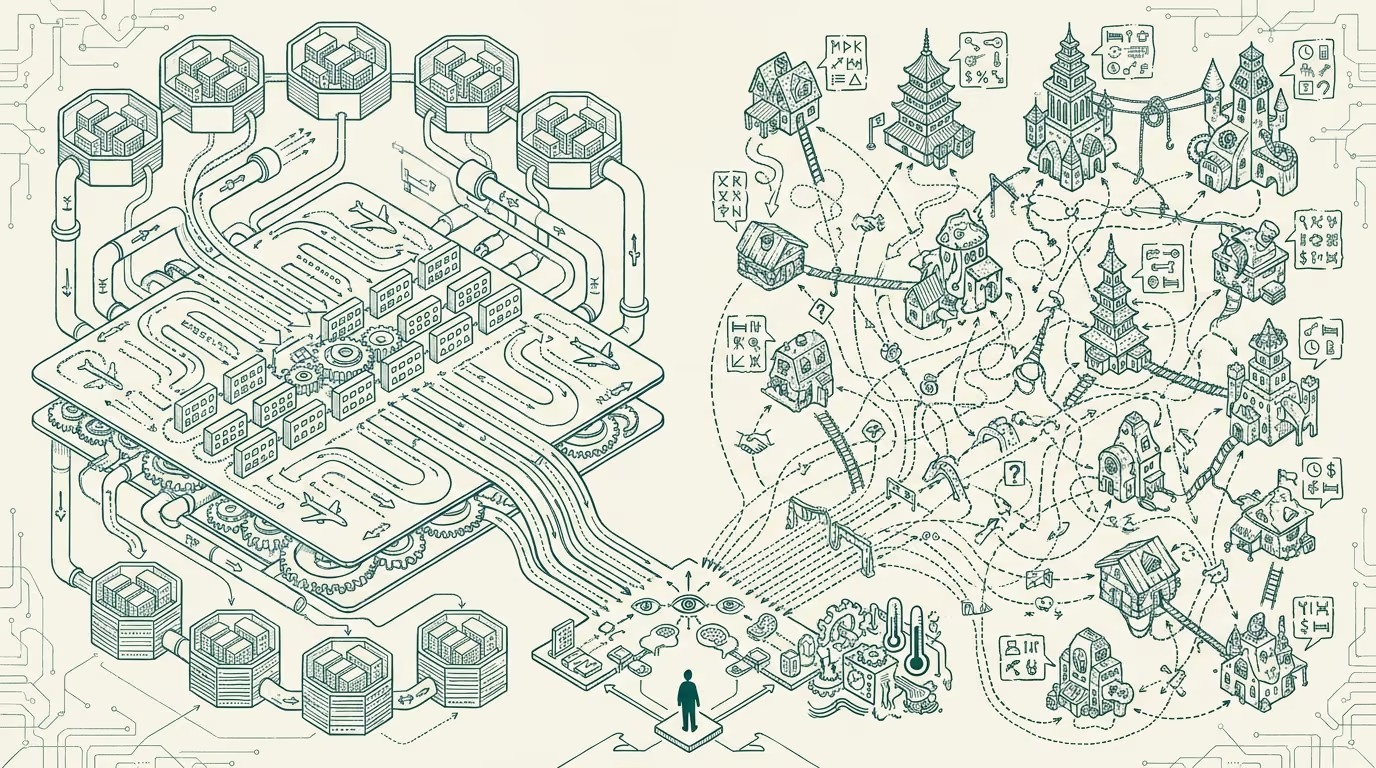
From the trade-press distance, hotels and airlines look like parallel travel categories. Both have running AI deployments. Both have shipped agentic-class consumer products through 2024-2025. Both have ongoing modernization in distribution and revenue management. Both have visible vendor-class investment from the major foundation-model providers and from the major SaaS platforms. The trade-press coverage of agentic AI in travel often groups the two categories together, with the same examples and roughly the same conclusions.
Up close, the two categories diverge structurally on a dimension that produces meaningfully different outcomes for the agentic-AI deployment. The hotel supply graph is fragmented in a specific way that the airline supply graph is not, and the agentic layer running on top of the fragmented graph carries operational and economic costs that the agentic layer running on top of the commoditized airline graph does not.
This piece walks the visible-parity, the structural divergence, three operator-grade receipts from the routing-and-availability stack at a mid-cap OTA where the agentic layer has been in production through 2024-2025, and what Airbnb's AI fourth-pillar positioning reveals about the divergence.
The visible parity
The visible-parity story between airlines and hotels for agentic AI is straightforward. Both categories have major OTA-side AI deployments (Booking's AI Trip Planner, Expedia's Romie and the broader chatbot offerings, Tripadvisor's AI assistant, the AI-augmented search-and-recommendation features across the major platforms). Both have direct-channel AI deployments at the major carriers and chains (United's customer-service AI, Delta's customer-service AI, Marriott Bonvoy's AI features, Hilton's Connie successor work). Both have specialty-vendor activity in the agentic trip-planning space.
The trade-press read on this is that the two categories are running parallel modernization tracks with similar timelines and similar economics. The read is wrong about the timelines and the economics. The two categories are running structurally different deployment patterns that the press coverage has not been generally surfacing.
The structural divergence
The structural divergence is on the supply graph. Airlines run a finite, regulated, structurally commoditized supply graph. There are roughly 200 commercially-relevant airlines globally. Each carrier publishes its inventory through standardized distribution mechanisms (the GDS systems plus NDC, increasingly). The fare-class structure, the inventory-management infrastructure, the routing rules, the schedule-and-availability data: all of these are standardized enough that an agentic layer can reliably query the supply graph, get accurate availability, get accurate pricing, and route a customer through a bookable itinerary with high success rates. The agentic layer's job on airline supply is mostly the customer-side reasoning (what trip the customer wants, given their stated preferences) because the supply-side reasoning is largely deterministic against the structured inventory.
Hotels run a fragmented, unregulated, structurally non-commoditized supply graph. There are roughly 700,000-800,000 commercial hotel-and-resort properties globally, plus several million vacation-rental properties that the agentic layer often needs to reason about alongside the hotel supply. Each property has its own inventory, pricing, content (room descriptions, amenities, photos), policy structure, and update cadence. The data flows through a long tail of channel-management vendors, hotel-and-property-management systems, and direct-API surfaces, with substantial inconsistency in the data quality across the layer. The agentic layer's job on hotel supply requires not just customer-side reasoning but also significant supply-side reasoning to handle the inconsistency, the data-staleness, the property-specific edge cases, and the long-tail availability problems.
The result is that the agentic layer's failure modes on hotel supply are substantially more frequent and substantially harder to handle than the failure modes on airline supply. The customer asking for a hotel that meets specific preferences (a beach resort with kid-friendly amenities, a city hotel with extended-stay capability and a kitchen, a property with specific accessibility features) hits the fragmented supply graph in ways that produce wrong answers, incomplete answers, or answers that fail at the booking-confirmation step. The agentic layer's success rate on hotel queries is meaningfully lower than on airline queries.
Three operator-tier receipts
Three operator-grade receipts from the routing-and-availability stack at a mid-cap OTA's agentic deployment, presented at the level of pattern observation.
The first receipt is from the property-content-quality layer. The agentic system reads the property's content (room descriptions, amenities, photos, policies) to determine whether the property matches the customer's request. The content quality varies dramatically across the supply graph. Major chains have relatively well-structured content. Independent properties have content that ranges from excellent to nonexistent. The agentic layer that recommends a property based on partial or stale content will sometimes recommend a property that does not actually match the customer's stated needs, with the customer discovering the mismatch at check-in. The OTA's customer-service teams handle the complaint volume from these mismatches, which has grown alongside the agentic deployment.
The second receipt is from the availability-and-pricing freshness layer. Hotel availability and pricing change continuously across the day, with substantial variation across the channel-manager-and-distribution-system stack. The agentic layer's cached snapshot of availability can be out-of-date by minutes or hours, depending on the property and the channel. The result is that the agentic system will sometimes confirm to the customer that a specific room at a specific price is available, and the booking will fail at the confirmation step because the availability has changed. The failure rates here are not large in percentage terms but are large enough to matter for the customer-trust experience the agentic deployment is meant to produce.
The third receipt is from the policy-and-rules-engine layer. Hotels have property-specific policies (cancellation rules, deposit requirements, age restrictions, pet policies, amenity-specific rules) that the agentic layer must accurately represent to the customer. The policy structure is unstandardized across the supply graph. The agentic layer that summarizes a property's cancellation policy can produce summaries that are partially or wholly inaccurate, with the customer discovering the inaccuracy when they try to cancel. The OTA's legal-and-customer-service exposure on these inaccuracies is real and is part of the operational cost of the agentic deployment that the press coverage of the deployment has not generally captured.
The three receipts share a structural cause: the supply graph is fragmented enough that the agentic layer's reasoning operates against incomplete or inconsistent information at every step. The same agentic layer running against airline supply does not see these failure modes at comparable rates because the airline supply graph is structurally cleaner.
The Airbnb signal
Airbnb announced its AI strategy in mid-2025 as a four-pillar approach: vacation-rental marketplace plus three additional pillars (experiences, services, and an AI agent that helps travelers across the categories). The AI-agent positioning as a fourth pillar rather than a feature of the marketplace is the signal worth reading carefully. Airbnb is acknowledging, structurally, that its agentic layer is not a marketplace feature but a separate product with separate operational economics.
The reason this matters is that Airbnb's marketplace runs on supply that is even more fragmented than the broader hotel supply graph. Vacation-rental properties have content quality, availability freshness, and policy variation that is even more inconsistent than the chain-and-independent hotel supply. The agentic layer running on top of the Airbnb marketplace would face all of the failure modes the OTA receipts above describe, with the additional complexity of host-tier interaction (host-approval workflows, host-policy variation, host-side communication patterns).
By positioning the AI agent as a separate pillar, Airbnb is acknowledging that the agentic-and-marketplace economics are different and that the agentic layer requires its own product strategy, its own operational infrastructure, and its own success-and-failure modeling. The four-pillar architecture is the public version of the operational read that the supply-graph fragmentation produces structurally different agentic deployment economics.
The signal is also the company's read on where the value capture in the next few years will live. The marketplace is the existing business. The three new pillars (experiences, services, AI agent) are the bets on where the supply-graph-fragmentation problem can be turned into a structural advantage rather than a structural cost. The operator-class read on Airbnb's strategy in 2025-2027 should attend to which of the four pillars the company actually delivers on, because the four-pillar positioning is signaling that the company knows the agentic layer is harder than the marketplace was and is preparing for that.
What the operator class should take from this
The structural read on agentic AI in travel is that the airline category is significantly easier and the hotel category is significantly harder than the trade-press parity coverage implies. Founders building agentic-AI products in the travel category should price the difference accurately. Building for the airline supply graph runs against a tractable supply-side reasoning problem. Building for the hotel supply graph runs against a fragmented supply-side reasoning problem that consumes meaningful engineering and operational capacity that the airline-focused build does not need.
For investors evaluating agentic-travel products, the supply-side fragmentation question should be one of the first diligence questions. A vendor pitching a horizontal travel-AI product without a clear answer for the hotel-supply-fragmentation problem is pitching against the easier half of the category and ignoring the harder half. A vendor with a credible answer (proprietary supply-data work, deep integration with the channel-management layer, specialty vertical positioning that sidesteps the fragmentation) has a structurally more defensible product.
The hotel category is broken in a way the airlines are not. The breakage is structural and is not going away. The agentic layer running on top of it will continue to struggle until the supply-graph fragmentation gets addressed at the data-and-distribution layer, which is a multi-year project that no single vendor can complete alone. Airbnb's four-pillar positioning is signaling that the company has read this. The other operators in the category should be reading it too.
—TJ