The AI-in-everything wave broke earlier than consensus expected. McDonald's and Klarna are the receipts.
The 2024 venture-class consensus was that the AI-in-everything wave had at least 24-36 months of expansion ahead, with consumer-facing and enterprise-tier products both adding AI features at sustained pace through 2025-2027. The investment thesis priced in continued growth in the surface-feature layer and used that growth to justify substantial valuation premiums on AI-feature-shipping companies and AI-tooling vendors.
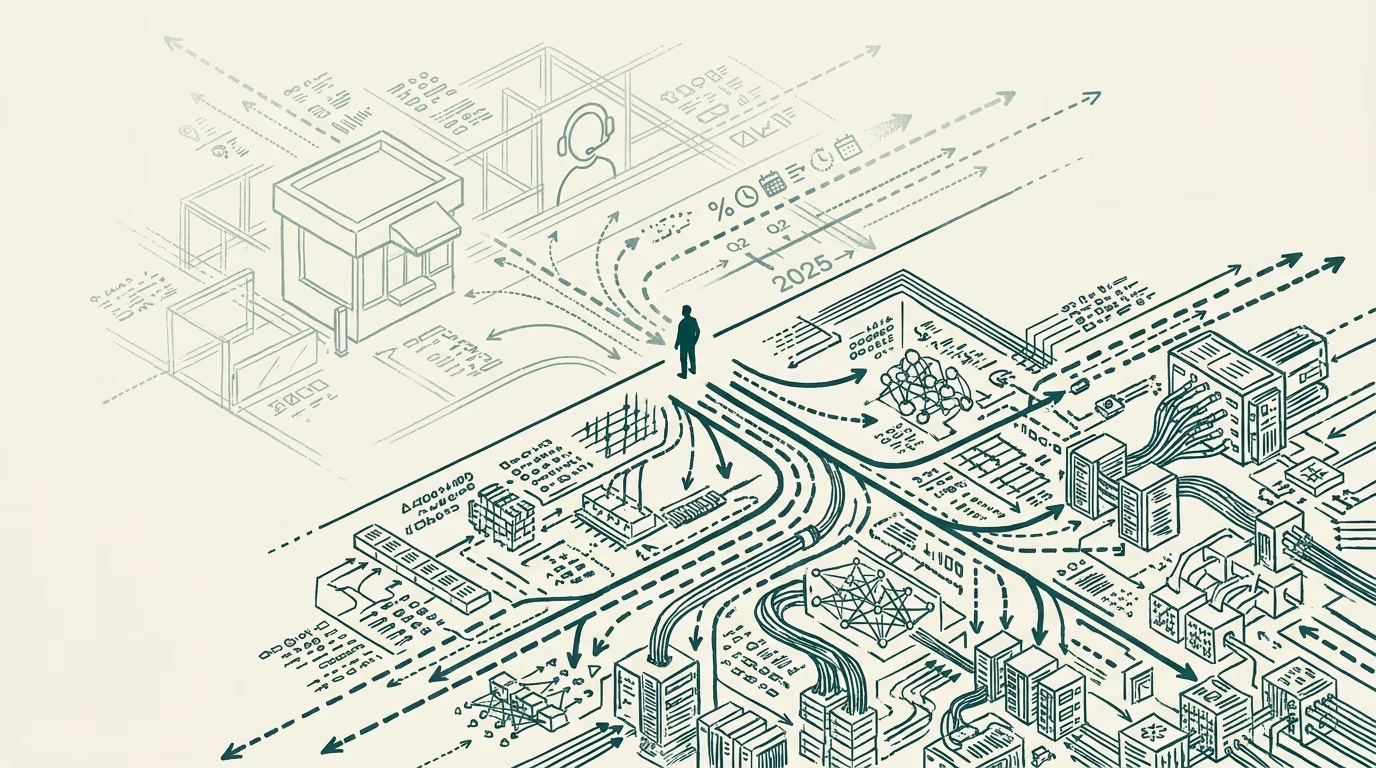
The actual trajectory tells a different story. The surface-feature layer peaked sometime around Q2 2025 and has been visibly receding since, with several major-brand walkbacks landing through the second half of the year. McDonald's ended its IBM-partner drive-thru AI program.Klarna publicly walked back its AI-replaces-customer-service rollout and began rehiring human customer-service capacity. Several other major consumer-and-retail brands quietly retired or rebuilt AI features that had been launched with substantial press through 2023-2024. The wave the consensus had priced in did not break in the way the consensus expected.
The deep-integration layer kept growing through the same period, mostly invisibly to the consumer-facing surface. This essay walks the wave, the receipts, the deep-integration layer that grew while the surface receded, the structural difference between the two halves, and what the structural read on the next 12-18 months should be.
The wave the consensus priced in
The 2023-2024 consumer-facing wave had a recognizable shape. Major brands launched AI features in their consumer-facing products with substantial marketing investment. The features ranged from chat-class assistants on websites and apps, to AI-augmented customer-service flows, to recommendation-and-personalization features, to drive-thru ordering automation in quick-service restaurants. The launch communications were accompanied by broad trade-press coverage that priced the features as the visible front of the AI revolution in consumer products.
The venture-class consensus read this wave as the leading edge of a multi-year deployment trajectory. The investment-class allocation followed accordingly, with valuations on AI-feature-shipping companies running well above what the underlying unit economics would have justified in a non-AI category. The premise was that the wave would continue and the unit economics would catch up to the valuations as the features matured.
The McDonald's and Klarna receipts
The McDonald's drive-thru AI partnership was launched with substantial publicity through the early-2020s and ran in pilot deployment across selected U.S. locations. The performance issues with the pilot were publicly visible through 2024, with documented order-accuracy problems that produced customer-experience friction. McDonald's announced the end of the partnership in mid-2024, with the public framing leaving the door open to alternative AI-vendor work but with the operational reality being that the surface-feature deployment had not produced the customer-experience improvement the launch communications had implied.
The Klarna AI-customer-service rollout was launched in early 2024 with public communications that framed the AI deployment as replacing substantial human-customer-service capacity. The rollout produced visible customer-experience problems through 2024-2025, with negative customer commentary surfacing in volume. Klarna publicly acknowledged the issues in mid-2025 and announced a rebalancing of the customer-service workforce that re-introduced human capacity at meaningful scale. The framing was not a full retreat but the operational reality matched the McDonald's pattern: the surface-feature deployment did not produce the customer-experience improvement the launch communications had implied.
Several other major consumer-and-retail-brand AI deployments produced similar shapes through 2024-2025. The pattern was consistent: surface-feature deployment with substantial launch publicity, performance issues that emerged in production, walkback or rebuild work that received less publicity than the launch had.
What kept growing
Through the same period, the deep-integration AI deployment layer continued to grow at substantial pace. Examples include the back-office operations work discussed elsewhere (claim-routing, prior-auth processing, dispatch-and-fuel optimization, crew-scheduling, IROPS recovery), the engineering-tooling layer (Copilot, Cursor, Claude Code, the broader AI-augmented developer-tools category), the platform-tier integrations (Salesforce Agentforce, Microsoft Copilot Studio, ServiceNow's agent offerings), and the enterprise-tier vertical applications that have been shipping quietly into specific operational contexts.
The deep-integration layer's growth has been less press-friendly than the surface-feature layer's launch cycle was. The deployment work happens inside enterprise IT integrations, the success metrics are operational rather than customer-experience-visible, and the failure modes are caught internally rather than producing public customer-complaint surfaces. The result is that the deep-integration growth has been substantial and largely invisible to the consumer-facing trade-press cycle that read the surface-feature recession as the broader AI trajectory.
The structural difference
The structural difference between the two halves of the deployment landscape is the buyer-and-evaluation environment. The surface-feature deployments faced consumer-class users with weak-to-no commitment to the deploying brand and substantial willingness to publicly criticize when the features failed. The customer-experience visibility of the failure modes meant that the brand's reputational cost of a poor deployment was high, with the result that the brands have been reluctant to absorb the reputational cost and have walked back deployments where the features have not proven reliable.
The deep-integration deployments face enterprise-class buyers with substantial commitment to the deploying vendor (multi-year contracts, deep procurement-and-integration cycles, internal IT teams with operational visibility into the deployment). The operational visibility of the failure modes means that the failures get caught and remediated internally rather than producing the public reputational cost. The deep-integration deployments are also typically operating against problem shapes that are well-fitted to the agentic-AI architecture (clear goals, bounded constraints, low ambiguity, measurable outcomes), as opposed to the consumer-facing deployments that are typically operating against problem shapes that are less well-fitted.
The combined effect is that the surface-feature layer recedes while the deep-integration layer grows. The two halves are not the same trajectory, and the venture-class consensus that read them as a single trajectory missed the structural difference.
What the operator class should take from this
For founders and investors evaluating the AI deployment category through 2025-2026, the part that holds is to distinguish the two halves cleanly. The surface-feature deployments are likely to continue receding through 2026, with selective rebuilds where the underlying problem shape is well-fitted to the AI architecture and the brand can absorb the development time. The deep-integration deployments are likely to continue growing through 2026 and beyond, with the operational ROI compounding as the deployment infrastructure matures.
The investment-class read suggests that the surface-feature-shipping companies that priced into the 2024 consensus are likely to be over-valued relative to the trajectory the second half of 2025 has revealed. The deep-integration vendors are likely to be priced more accurately because their deployment trajectory has been visible to the enterprise-buyer-tier without requiring consumer-class validation.
For the operator-class evaluating their own AI-deployment strategy, the read is to invest in the deep-integration layer where the problem shape and the buyer-environment supports it, and to be cautious about surface-feature deployments where the consumer-class evaluation environment will produce substantial reputational risk if the deployment underperforms.
The AI-in-everything wave the consensus expected did not arrive on the timeline the consensus expected, at least at the surface-feature layer. The deep-integration wave kept going. The two halves of the deployment landscape have different trajectories, and the durable read should be calibrated against both, not the single-trajectory framing the venture-class consensus had been pricing in.
—TJ