The travel hacker is now a vintage profession.
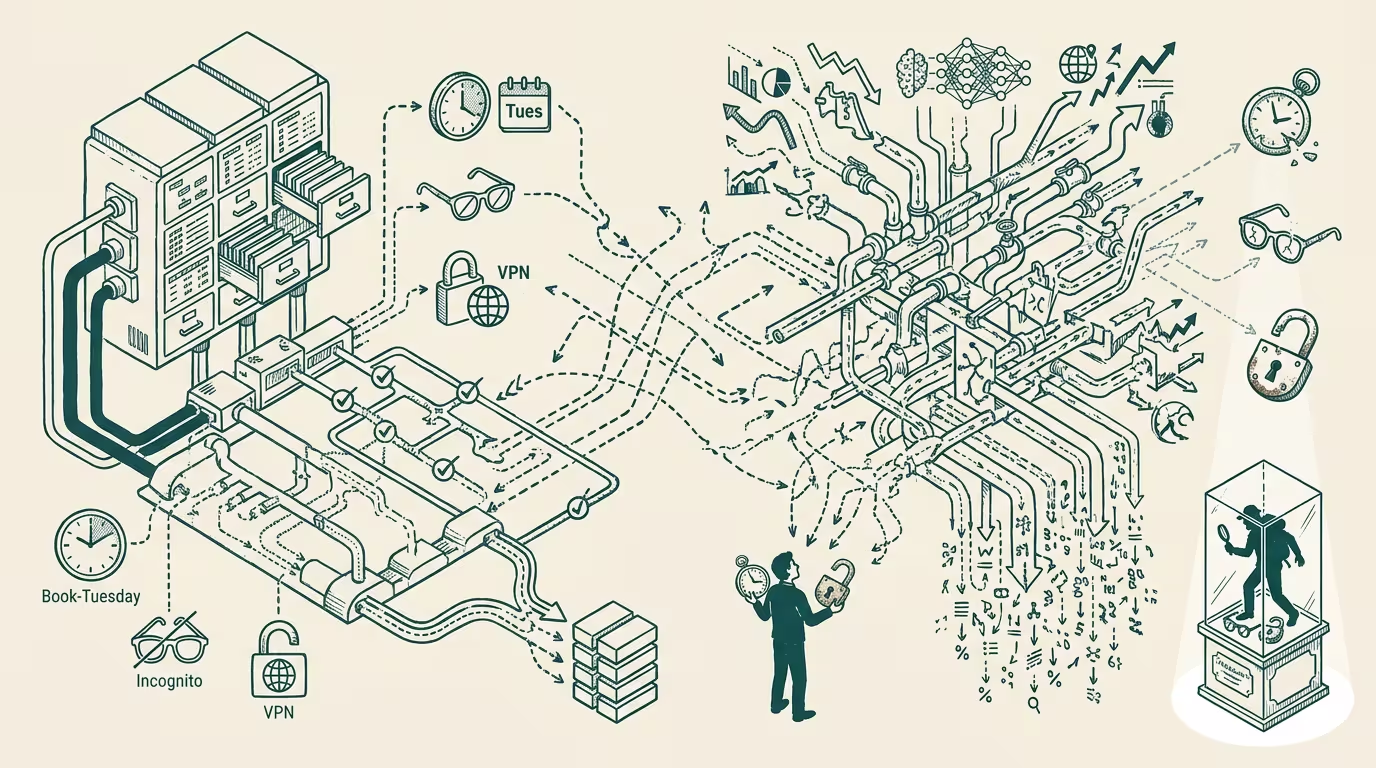
Delta, Marriott, and OYO collectively change prices roughly 15 million times per day across their inventories in 2025. The numbers come from the operator-class disclosures and the third-party pricing-intelligence vendors who track them. The pricing-engine architecture moved through 2024-2025 from rule-based systems (cleared rules, scheduled adjustments, marketing-class promotions) to generative-AI-class systems that learn customer intent in real time and price against it.
The two-decade consumer toolkit — _book Tuesday, use incognito, run a VPN, clear cookies, search at 3am_ — is being neutralized.
The travel hacker is now a vintage profession.
Trace how the neutralization happened. Pre-2024 pricing changed at intervals slow enough that consumer behavior could adapt. Read the airline blog, learn the pattern, exploit the gap. The consumer's information advantage was constant: the seller's pricing logic was rule-based, and rule-based logic is reverse-engineerable. The travel-hacker community spent two decades reverse-engineering the rules, publishing the patterns, exploiting the gaps. The toolkit worked.
Post-2024 pricing changes faster than consumer behavior can adapt because the AI is learning the consumer's intent faster than the consumer learns the AI's pattern. The asymmetry is now structurally unidirectional — the seller knows more about the buyer in real time than the buyer can learn about the seller's pricing behavior. The rules that the travel hacker reverse-engineered are gone, replaced by a model whose logic is not reverse-engineerable through the techniques the toolkit teaches. That is the shift the travel-hacker discourse hasn't fully absorbed.
What rises in response is a secondary market for consumer-side AI tooling. When the seller's AI is the binding constraint, the consumer's defense is their own AI. Honey-class browser extensions, cashback aggregators, and the emerging class of "buying agents" (Operator-class consumer agents that negotiate or comparison-shop on behalf of users) become the consumer's mechanism for re-leveling the asymmetry. The market is structurally significant because the asymmetry creates persistent demand. Operators in adjacent categories (insurance, financial-services, healthcare-procurement) will see the same secondary-market emergence within 24-36 months as their pricing engines also move from rule-based to generative.
What lags is the regulatory frame. Discrimination law, anti-trust law, and consumer-protection regulation each assume the pricing mechanism is something that can be inspected, audited, and compared across consumers. Generative-AI pricing produces personalized prices that don't decompose to inspectable rules. The regulatory frame is going to have to develop new mechanisms for engaging with personalized AI pricing, and the development will lag the deployment by 18-36 months. In the interim, operators deploy AI pricing under regulatory ambiguity; consumers absorb the asymmetry.
The same arc recurs across categories where AI pricing is replacing rule-based pricing. Insurance: the deal-shopper as vintage profession. Financial-services: the rate-arbitrageur as vintage profession. Retail: the coupon-hacker as vintage profession. Each category has its own version of the same neutralization.
What survives all of this is that consumer-class arbitrage practices that worked through 2010-2024 are operating-stale through 2025-2026, the secondary market for consumer-side AI tooling is the operator-grade response, and the regulatory frame is going to lag the deployment by 18-36 months. The travel hacker isn't dead — the travel hacker is now a museum-class profession with vintage techniques. The professional class continues to exist and the techniques continue to work in narrow categories. The category-leader practitioner is increasingly running an AI of their own against the seller's AI.
Two AIs negotiating a hotel rate, with the consumer and the operator as observers, is the 2027 baseline. By 2028 the negotiation layer will be standard infrastructure.
—TJ